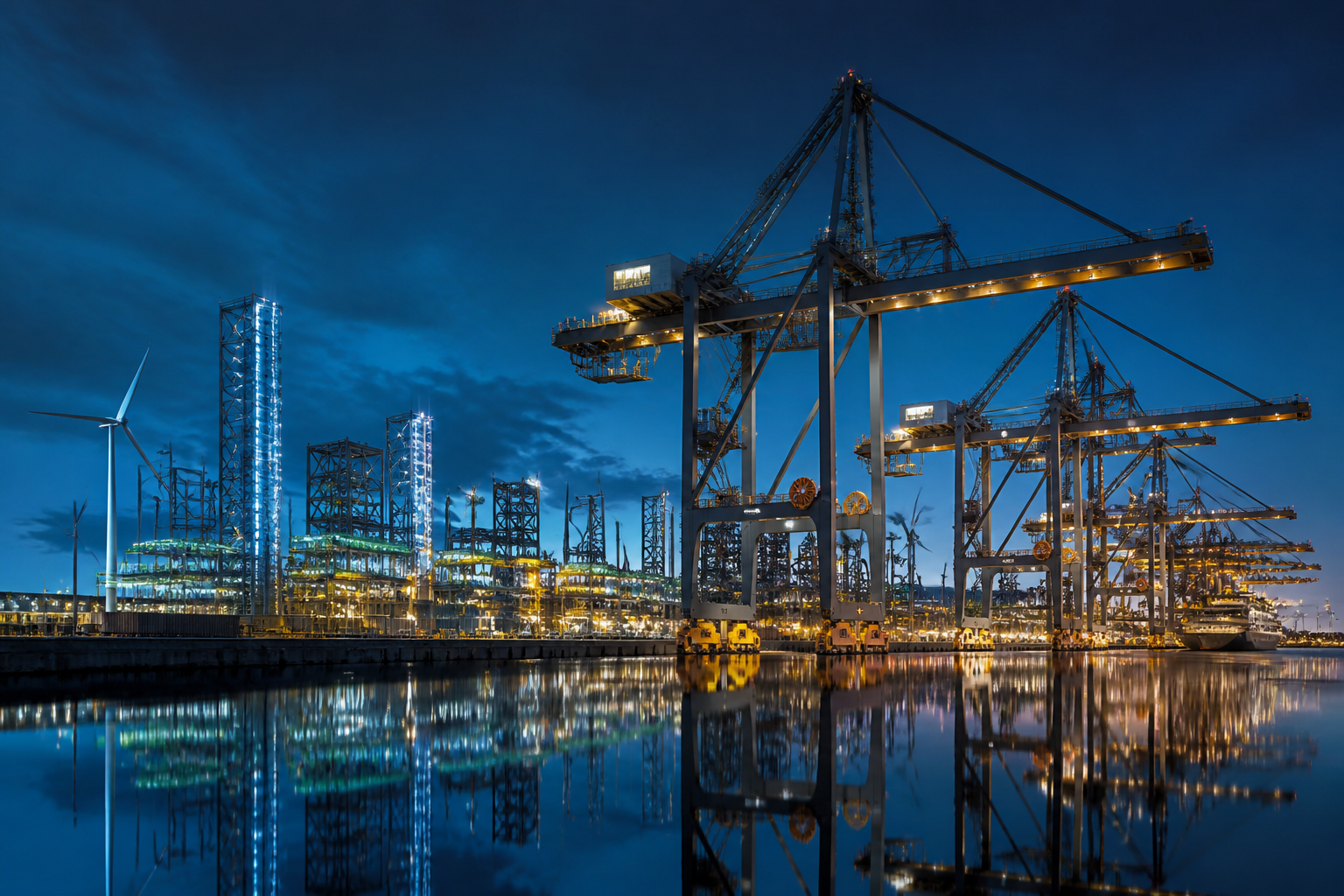
The Scaffolding of Sovereignty: Reimagining Global Infrastructure in a Fragmented Epoch
A deep analysis of the evolving infrastructure landscape, examining how geopolitical shifts, fiscal constraints, and the green transition are reshaping the fundamental architecture of the global economy through 2026.
The global economic landscape is currently navigating a period of profound restructuring, where the invisible hand of the market is increasingly guided by the visible hand of the state. As we observe the latest data from the BlackRock Investment Institute and Deloitte Insights, it is evident that the traditional paradigms of infrastructure investment are being dismantled in favour of a more assertive, security-oriented framework. This evolution is not merely a response to the lingering aftershocks of inflationary pressure but a fundamental realignment of how sovereign entities perceive their physical and digital foundations. The era of ‘just-in-time’ connectivity is yielding to a doctrine of ‘just-in-case’ resilience, necessitating a colossal reallocation of capital towards projects that can withstand both climatic volatility and geopolitical fragmentation. Consequently, the scaffolding of the modern economy is transitioning from a facilitator of low-cost commerce to a primary instrument of national and regional survival.
The Fiscal Crucible and the Cost of Capital
Central to the current infrastructure predicament is the enduring reality of the ‘higher-for-longer’ interest rate environment. Despite periodic fluctuations in the S&P 500 and the occasional softening of bond yields, the cost of financing large-scale civil engineering projects remains significantly elevated compared to the previous decade. According to recent economic calendars from Yahoo Finance and analytical syntheses from Bloomberg Economics, the hurdle rates for long-duration assets have undergone a permanent upward shift. This fiscal crucible has forced a rigorous prioritisation of projects; those lacking a direct link to energy security or technological supremacy are increasingly find themselves sidelined. Institutional investors, once content with the steady, inflation-linked returns of utility assets, are now demanding higher risk premiums to compensate for the political uncertainties inherent in today’s fragmented trade corridors. This shift is particularly visible in the commercial real estate sector, where Altus Research notes a widening divergence between prime, sustainable assets and a massive surplus of legacy stock that lacks the capital necessary for retrofitting.
The Geopolitics of Connectivity and Corridor Competition
Infrastructure is no longer a neutral endeavour; it is the theatre in which the great power competition of the twenty-first century is being staged. The competition between the West’s ‘Global Gateway’ initiative and various integrated Eurasian networks has created a bifurcated maps of global logistics. National governments are increasingly viewing undersea cables, rare-earth processing facilities, and semiconductor fabrication plants not merely as commercial entities but as sovereign bastions. The recent reported movements toward de-escalation in Middle Eastern hotspots, while providing temporary relief to Brent crude prices, do little to alter the underlying trend of strategic decoupling. We are witnessing the emergence of ‘aligned corridors’ where infrastructure spending is dictated by ideological proximity as much as by geographical logic. This trend necessitates that multinational firms navigate a complex web of varying regulatory standards and security protocols, significantly increasing the overhead of international expansion and complicating the long-term planning cycles essential for infrastructure development.
The Energy Transition as a Structural Imperative
Perhaps the most significant driver of infrastructure demand is the accelerating transition towards a low-carbon economy. This is no longer an environmental aspiration but a structural imperative mandated by both legislative frameworks and the hard physics of a changing climate. The electrification of everything requires a wholesale reimagining of the grid, a task that Deloitte suggests is currently underfunded by several trillion dollars globally. The shift from centralised fossil-fuel generation to distributed renewable sources necessitates an unprecedented investment in storage technologies and high-voltage transmission lines. However, the paradox of the green transition is that it remains highly resource-intensive, requiring vast quantities of copper, lithium, and steel, the prices of which are increasingly volatile. Furthermore, the ‘not-in-my-backyard’ sentiment often delays the very projects intended to secure a sustainable future, creating a tension between democratic consultation and the urgent necessity of systemic overhaul.
Digital Foundations and the AI Infrastructure Arms Race
Beneath the physical layer of roads and rails lies the digital stratum, where the demand for data processing capacity is expanding at an exponential rate. The surge in generative artificial intelligence has ignited what can only be described as an infrastructure arms race for data centres and the energy networks required to sustain them. Major technology conglomerates are now among the world’s largest infrastructure spenders, bypass traditional utility models to build their own proprietary power supplies and cooling systems. This privatisation of critical digital infrastructure raises significant questions regarding public oversight and systemic vulnerability. As Bloomberg’s economic coverage highlights, the concentration of digital power within a handful of hyper-scalers creates a new form of monopoly that regulators are only beginning to comprehend. The challenge for policymakers is to ensure that the digital backbone of the economy remains resilient and accessible to a broad spectrum of participants, rather than becoming a series of walled gardens controlled by a few dominant players.
Urban Resilience and the Future of the Megacity
The physical manifestation of today’s infrastructure challenges is most apparent in the world’s burgeoning megacities. From the sinking coastal metropolis of Jakarta to the heat-stressed urban canyons of London and New York, the built environment is under physical duress. Altus Research points out that the traditional model of the central business district is being reshaped by the intersection of remote work and the need for climate-resilient architecture. Infrastructure must now perform a dual role: it must facilitate economic productivity while simultaneously acting as a defensive barrier against environmental volatility. This requires a shift towards ‘nature-based solutions,’ such as urban wetlands and permeable pavements, integrated into traditional grey infrastructure. The financial burden of this urban adaptation is immense, and it is likely to necessitate innovative public-private partnerships that can bridge the gap between municipal budgets and the scale of the required transformation.
A New Social Contract for Infrastructure
As we look toward the latter half of this decade, it is clear that a new social contract regarding infrastructure is emerging. The public is increasingly aware that the quality of their physical environment, the reliability of the grid, the efficiency of transit, and the security of digital networks, is a primary determinant of their quality of life. Governments that fail to deliver these essential services risk profound social unrest and political instability. Conversely, those that successfully manage the transition to a more resilient and sustainable infrastructure framework will gain a significant competitive advantage in the global economy. This will require not only capital but also a visionary approach to planning and a willingness to confront the legal and regulatory bottlenecks that have long stifled progress. The winners of the next decade will be the nations and corporations that treat infrastructure not as a sunk cost, but as a dynamic platform for innovation and survival.
Outlook for 2027 and Beyond
The trajectory for the coming years suggests a period of intense construction activity punctuated by resource scarcity and political friction. We anticipate that the ‘infrastructure-as-a-service’ model will gain further traction, as municipalities seek to offload the operational risks of complex systems to private specialists. While the immediate focus remains on energy security and digital capacity, the long-term winners will be those who can integrate these disparate systems into a cohesive, intelligent whole. The convergence of 5G connectivity, the Internet of Things, and advanced materials will allow for ‘smart’ infrastructure that can self-diagnose and adapt to changing conditions in real-time. However, the overarching theme will remain one of resilience. In an era defined by uncertainty, the most valuable attribute of any infrastructure asset is its ability to ensure continuity in the face of the unexpected. The transition may be turbulent, and the costs will undoubtedly be high, but the alternative, a decaying foundation in a volatile world, is an expense that no modern civilization can afford to bear.