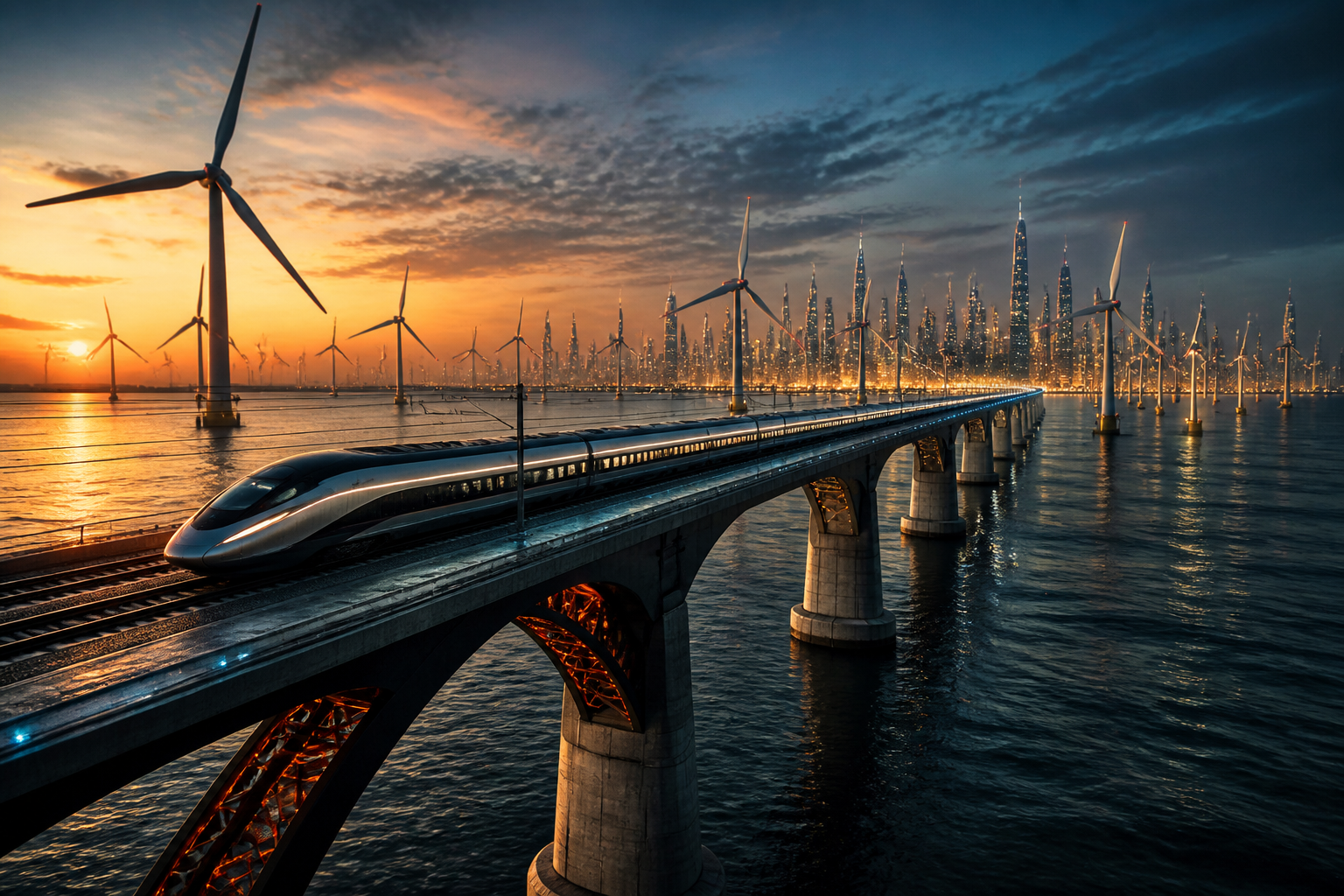
The Global Scramble for Resilience: Reimagining Infrastructure in an Era of Fragility
In a world defined by decarbonisation and logistical disruption, infrastructure evolves from a quiet utility into a primary instrument of statecraft. We explore the shifting paradigms of global capital deployment.
The global infrastructure landscape is currently undergoing its most profound transformation since the post-war reconstruction era. While the immediate post-Cold War decades were characterised by a relentless pursuit of efficiency and the seamless flow of goods across low-friction borders, the contemporary environment is defined by a shift towards 'just-in-case' resilience. Institutional investors and sovereign states are no longer merely seeking the highest yield from a bridge or a port; they are recalibrating their portfolios to withstand the increasing volatility of the 2020s. From the integration of advanced artificial intelligence into electricity grids to the hardening of maritime supply chains against geopolitical shocks, infrastructure has moved from the periphery of economic planning to its very core. Recent data from the BlackRock Investment Institute and Deloitte suggest that while inflationary pressures have proved more stubborn than many central bankers anticipated, the appetite for real assets remains extraordinarily robust, driven by the dual imperatives of the energy transition and the digitisation of the global economy.
The Fiscal Tightrope and the Private Capital Mandate
As national treasuries grapple with the lingering effects of high interest rates and the fiscal overhang of the pandemic era, the traditional model of state-funded infrastructure is being radically reconsidered. In both developed and emerging markets, the 'fiscal space' available to governments is narrowing, creating an urgent necessity for private capital participation. The Yahoo Finance economic calendar highlights a forthcoming series of central bank communications that will likely signal a 'higher-for-longer' interest rate environment, complicating the cost of debt for large-scale capital projects. For institutions such as Macquarie and Brookfield, this presents a paradox: higher rates increase the cost of capital, but the inflationary environment simultaneously enhances the value of assets with index-linked revenue streams. We are witnessing a professionalisation of the public-private partnership model, moving away from the precarious contracts of the past towards more transparent, long-term frameworks that satisfy both the fiduciary duties of pension funds and the service requirements of the public.
Decarbonisation and the Grid Revolution
The transition to a low-carbon economy remains the singular most expensive undertaking in human history. The International Energy Agency has repeatedly warned that the current pace of investment in electrical grids must double if we are to meet the collective targets set by the Paris Agreement. This is not merely an environmental concern but a fundamental issue of economic security. In Northern Europe and North America, the integration of intermittent renewable sources, primarily offshore wind and solar, is placing unprecedented strain on legacy transmission systems designed for centralised fossil fuel generation. The recent recovery in technology stocks, as noted by market analysts, reflects a broader confidence in the 'smart grid', a convergence of heavy engineering and sophisticated software that allows for real-time demand response. Companies such as Siemens Energy and Schneider Electric are at the forefront of this industrial pivot, where the goal is no longer just the generation of power, but the intelligent management of its distribution across increasingly fragmented networks.
Geopolitics and the Re-shoring of Logistics
The maritime and logistics sectors are perhaps the most sensitive indicators of the shifting geopolitical winds. The days of unbridled globalisation are being replaced by a more fragmented 'hub-and-spoke' model, where supply chains are shortened and regionalised to mitigate risk. Bloomberg Economics recently highlighted the strategic refocusing of trade routes, as the U.S. and its partners pursue 'friend-shoring' policies to insulate critical technologies from adversarial influence. This geopolitical re-alignment is manifesting in the physical world through the expansion of port facilities in Mexico, Vietnam, and India, which are rapidly becoming the new nodes of global manufacturing. However, this transition is fraught with challenges; the expansion of a port terminal or the construction of a rail corridor requires a decade of planning and stable political conditions, luxuries that are increasingly scarce in an era of heightened populist sentiment and frequent electoral volatility.
The Digital Backbone and the Future of Urban Real Estate
Infrastructure is increasingly synonymous with data. The traditional definition of the term, once limited to roads and pipes, now encompasses the fibre-optic cables and hyperscale data centres that facilitate the digital economy. Altus Research notes that the commercial real estate (CRE) sector is being fundamentally reshaped by this digital imperatives. While traditional office space in central business districts faces a structural decline in demand due to remote work trends, the demand for 'industrial' infrastructure, logistics hubs and data processing facilities, is surging. This shift represents a re-allocation of urban capital. The city of the late 21st century will not be defined by its high-rise office towers but by its subterranean data networks and its ability to manage the thermal loads generated by the massive computing power required for artificial intelligence. For urban planners, the challenge lies in integrating this heavy-duty digital infrastructure into the existing social fabric without exacerbating the 'digital divide' or placing excessive demand on local water and energy supplies.
Transport Connectivity in a Post-Carbon World
The transportation sector, responsible for a significant portion of global greenhouse gas emissions, is at the precipice of a technology-led overhaul. High-speed rail is experiencing a renaissance in parts of Asia and Europe as a credible alternative to short-haul aviation, which remains difficult to decarbonise. In the United Kingdom, despite the political controversies surrounding projects like HS2, the fundamental economic logic of increasing capacity and connectivity between regional hubs remains sound. Meanwhile, the electric vehicle revolution is necessitating a complete rethink of road infrastructure. The provision of widespread charging networks is no longer a niche requirement but a prerequisite for the survival of the automotive industry. This requires a level of coordination between utility providers, municipal governments, and private developers that has rarely been seen before. The winners in this space will be those jurisdictions that can move beyond pilot projects to the rapid, standardised deployment of infrastructure at a national scale.
The Forward-Looking Outlook: A New Strategic Consensus
Looking ahead, the success of the global infrastructure project will depend not on our ability to envision grand schemes, but on our capacity to execute them within more constrained economic and environmental parameters. The era of 'easy' growth, fueled by cheap debt and stable commodities, has concluded. In its place, we are entering a period of strategic investment where every kilometre of cable and every cubic metre of concrete must be justified by its contribution to long-term systemic stability. We anticipate a period of consolidation among infrastructure developers, as the complexity of modern projects demands greater technical expertise and deeper balance sheets. Furthermore, the role of multilateral institutions like the World Bank and the Asian Infrastructure Investment Bank will move from direct lenders to risk-mitigators, providing the guarantees necessary to unlock the trillions of dollars in private capital currently sitting on the sidelines. The road ahead is complex and geographically uneven, yet for the patient investor, the coming decade offers a rare opportunity to build the foundations of a more resilient global order.