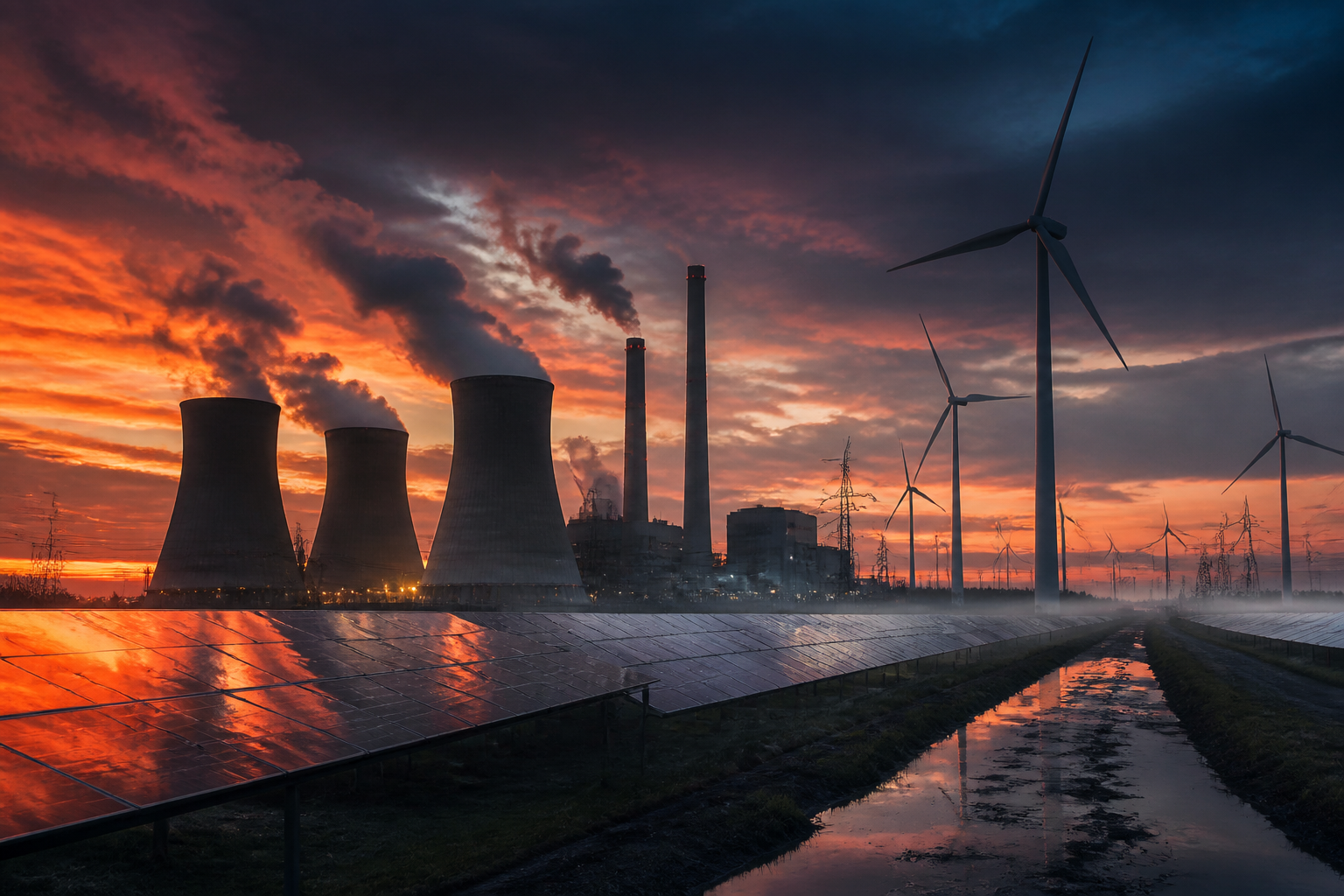
The Fossil Fuel Sunset: Navigating The Geopolitical Frictions Of The Global Energy Pivot
An analytical exploration into the fracturing global energy market, examining how the aggressive transition toward renewables in the West is creating new economic dependencies and strategic vulnerabilities for the East.
The global energy landscape is currently undergoing its most profound transformation since the dawn of the internal combustion engine, yet the transition is proving far less orderly than the idealistic projections of the Paris Agreement originally suggested. As the European Union accelerates its Green Deal and the United States deploys the Inflation Reduction Act to subsidise a domestic silicon-based industrial base, the unintended consequences of this rapid structural shift are manifesting as deep fractures in the traditional geopolitical order. The decoupling of Western capital from long-term hydrocarbon projects has not led to a universal cessation of fossil fuel extraction, but rather to a pivot where state-owned entities in the Middle East and the Russian Federation are consolidating their influence over the remaining market share. This editorial examines the precarious equilibrium between the necessity of decarbonisation and the inescapable reality of current industrial dependency, arguing that the rush toward a net-zero future is inadvertently empowering a new class of energy autocrats while placing immense inflationary pressure on the developing world.
The Strategic Fragility of the European Vanguard
Brussels has long positioned itself as the moral and regulatory vanguard of the energy transition, yet the Continent now finds itself in a state of chronic strategic fragility. The decision to dismantle coal and nuclear infrastructure in key economies such as Germany, while simultaneously attempting to sever ties with Gazprom following the invasion of Ukraine, has exposed a structural deficit that wind and solar are not yet equipped to fill. While the installation of Liquefied Natural Gas terminals along the North Sea coast has provided a temporary reprieve, the reliance on high-cost shipments from Cheniere Energy and other American exporters has permanently elevated the cost of industrial production within the Eurozone. This energy premium is already hollowing out the German manufacturing heartland, where chemical giants like BASF are shifting investment toward the United States and China to escape the prohibitive costs of European electricity. The transition, intended to foster energy independence, has instead traded a reliance on Russian pipelines for a dependence on volatile global spot markets and Chinese-dominated supply chains for photovoltaic cells and lithium-ion batteries.
The Resurgence of the Petrostates
Far from facing obsolescence, the traditional petrostates are enjoying a period of renewed relevance as they adapt to the shifting priorities of the West. Saudi Aramco and the Abu Dhabi National Oil Company have recognised that while Western supermajors such as BP and Shell are under immense shareholder pressure to divest from upstream exploration, the global demand for hydrocarbons remains near record highs. By continuing to invest in low-cost extraction, these Gulf entities are positioning themselves as the suppliers of last resort, ensuring that they will capture the final decades of the oil era with higher margins and greater market share. This consolidation of pricing power within the OPEC+ framework represents a significant challenge to the inflationary targets of Western central banks. The recent strategic cooperation between Riyadh and Moscow, despite the sanctions imposed by the G7, demonstrates that the control over physical energy flows remains a more potent lever of international influence than the regulatory frameworks designed in London or Paris. As capital costs for green projects rise alongside interest rates, the relative attractiveness of high-yield fossil fuel assets continues to persist in the private equity and sovereign wealth spaces.
China and the Monopoly on Transition Minerals
If the twentieth century was defined by the struggle for the control of oil fields, the twenty-first century will be defined by the mastery of the mineral supply chain. China has spent the better part of two decades executing a quiet but comprehensive strategy to monopolise the processing and refining of transition minerals, including cobalt, lithium, and rare earth elements. The International Energy Agency has repeatedly warned that the geographical concentration of these resources is significantly higher than that of oil, creating a new form of energy insecurity. While the Democratic Republic of the Congo provides the bulk of the world's cobalt, it is Chinese state-owned enterprises that control the majority of the mining concessions and the subsequent refining capacity. The Biden administration's attempts to counter this through domestic subsidies are a late entry into a race where Beijing already holds the pole position. For the automotive sectors of Europe and North America, the transition to electric vehicles represents a precarious leap from a diversified energy base to one where the primary inputs are controlled by a single geopolitical rival.
The Economic Divergence of the Global South
While the North Atlantic economies debate the merits of various carbon pricing mechanisms, the nations of the Global South face a more existential dilemma. For emerging economies such as India, Vietnam, and Indonesia, the primary objective remains the provision of affordable and reliable baseload power to support rapid urbanisation and industrial growth. The insistence by the World Bank and other multilateral lenders on restricting financing for high-efficiency coal and gas plants is increasingly viewed as a form of green protectionism that denies developing nations the same developmental path taken by the West. Prime Minister Narendra Modi has consistently argued that energy justice must precede climate targets, leading India to increase its domestic coal production even as it expands its solar capacity at a record pace. This divergence is creating a bifurcated energy market, where the West pursues a premium-priced, low-carbon grid, while the rest of the world continues to rely on the cheapest available caloric inputs, regardless of their carbon intensity. This reality suggests that global emissions will continue to rise in the near term, despite the aggressive decarbonisation efforts of the OECD nations.
Technology as the Final Arbiter
The eventual success of the energy transition will not be determined by international treaties or corporate pledges, but by the raw economics of technological breakthroughs. Carbon capture and storage, long dismissed as a convenient fiction for the fossil fuel industry, is now emerging as a necessary component for the decarbonisation of hard-to-abate sectors such as cement and steel production. Simultaneously, the revival of civil nuclear power, particularly the development of small modular reactors by firms like Rolls-Royce and NuScale, offers a pathway toward a stable, carbon-free baseload that renewables cannot yet provide. The hydrogen economy, though still in its nascent stages, represents the next great frontier for energy transport, with the potential to repurpose existing pipeline infrastructure. However, the capital intensity of these technologies remains a formidable barrier. Without a significant reduction in the cost of electrolysers and a standardisation of nuclear regulatory frameworks, the world remains trapped in a transitional purgatory, where the old system is being dismantled faster than the new one can be reliably constructed.
The Outlook for a Fragmented Century
Looking toward the mid-century horizon, the most likely scenario is not a clean break from the past, but a prolonged period of energy fragmentation and heightened volatility. The world is moving toward a multi-polar energy system where different regions will rely on vastly different primary sources, dictated by their geographical endowments and geopolitical alignments. The United States will likely leverage its shale abundance to maintain a degree of continental self-sufficiency, while Europe remains caught between its environmental ambitions and its industrial survival. China will continue to solidify its role as the global workshop of the green transition, using its industrial scale to drive down costs while simultaneously maintaining a massive coal-fired backstop. For investors and policymakers, the coming decade will require a sophisticated navigation of these overlapping realities. The era of cheap, abundant, and politically neutral energy is over, and in its place is an era where every joule of energy is a reflection of strategic intent and national security. The sunset of the fossil fuel age will be a long and litigious affair, defined more by the frictions of the pivot than by the clarity of the destination.