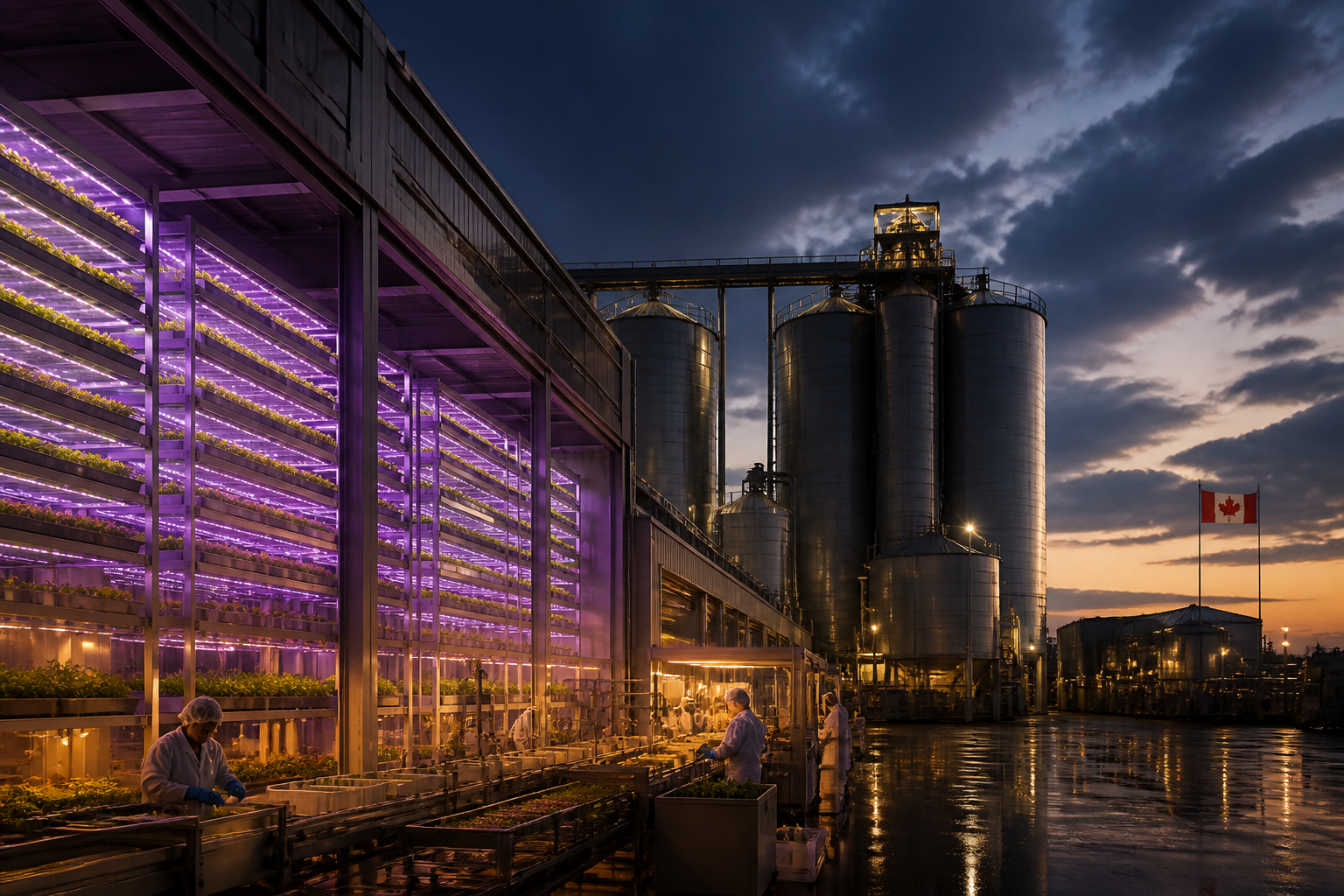
Capital Resilience And Agrarian Sovereignty In The Era Of Geopolitical Frictions
This editorial examines the strategic pivot towards agri-food sovereignty, focusing on recent billion dollar capital injections in Canada, European Union sustainable guarantees, and the broader global push for resilience.
The global agri-food landscape is currently undergoing a structural transformation as profound as the Green Revolution, though this contemporary shift is defined by geopolitical resilience rather than mere yield optimisation. For decades, the sector operated under the assumption of frictionless trade and ever-expanding globalisation, yet the compound shocks of pandemic disruptions, escalating climate volatility, and renewed territorial conflicts have exposed the fragility of lean, cross-border supply chains. Consequently, a new orthodoxy of agrarian sovereignty has emerged, where national governments and institutional financiers are no longer content to leave food security to the vagaries of the spot market. This strategic pivot is most evident in recent large-scale fiscal interventions, such as the Canadian government's billion-dollar liquidity injection through Farm Credit Canada, which signal a move towards proactive industrial policy in the primary and secondary agricultural sectors. As capital flows are redirected toward domestic processing capacity and climate-resilient infrastructure, the industry is transitioning from a period of efficiency-first logistics to a new era of security-focused investment.
The Strategic Imperative Of Domestic Processing
The recent announcement by the Honourable Minister MacDonald regarding the one billion dollar Agri-food Project Finance Fund marks a significant escalation in state-backed agricultural strategy. This fund, administered by Farm Credit Canada, represents more than a simple credit facility, it is a targeted instrument designed to address the chronic under-investment in large-scale value-added processing. For too long, resource-rich nations like Canada have functioned as exporters of raw commodities while remaining dependent on foreign facilities for the finished goods that stock domestic shelves. By providing the capital necessary for massive infrastructure projects, the Canadian state is attempting to insulate its economy from the inflationary pressures of international logistics and the risks of sudden trade barriers. Furthermore, the additional allocation of one hundred and fifty million dollars to Velocity Agri-Capital Partners demonstrates a sophisticated tiered approach to financing, combining traditional debt instruments with venture-led capital to foster innovation in high-growth sub-sectors. This bifurcated investment strategy acknowledges that while heavy infrastructure provides the backbone of security, it is the agile, technology-driven firms that will define the future of sustainable production.
Trade Diversification And The Fodder Paradox
While North America focuses on capital intensive infrastructure, the European market illustrates the complexities of maintaining production amidst shifting trade dynamics. Recent data from the USDA Foreign Agricultural Service regarding Spain highlights a peculiar stability in the face of chaos. Spanish dried fodder production has remained remarkably steady despite the volatility of Mediterranean trade flows and the persistent threat of aridification. This stability suggests that advanced agricultural economies are becoming increasingly adept at navigating trade redirects, finding new markets for surplus production while simultaneously securing essential inputs from unconventional sources. The Iberian case serves as a microcosm for a broader European trend where agriculturalists are forced to balance the rigid requirements of the Common Agricultural Policy with the fluid realities of global demand. The ability of Spain to maintain its output of essential animal feed components amidst regional instability underscores the vital role of adaptive supply chain management. It also points to the growing importance of regional trading blocs that can act as a buffer against the more erratic movements of the global commodity markets.
Sustainable Finance As A Tool For Stability
The intersection of finance and sustainability is no longer a matter of corporate social responsibility, rather, it has become a fundamental component of risk management. The European Investment Bank, through its EIB Global arm, has recently entered into an agreement with Centenary Bank in Malawi to provide seven point five million euros in financing for small agricultural businesses. While the headline figure may seem modest compared to North American funds, the structural design of this facility is highly significant. With half of the funding explicitly earmarked for sustainable agriculture and the remainder for women and youth-led enterprises, the European Union is using its Global Gateway initiative to export a specific model of agrarian development. By backing these loans with EU-financed guarantees, the institution is effectively de-risking the agricultural sector in emerging markets, encouraging local banks to lend to entities that were previously deemed too volatile. This approach recognizes that global food security is a networked problem, where instability in the Global South can have direct repercussions for international trade and migration patterns in the North.
Technology Adoption And The Digital Agrarian Frontier
Central to the success of these massive capital infusions is the rapid adoption of digital technologies that promise to heighten efficiency and reduce the environmental footprint of farming. The evolving trade dynamics mentioned by FCC Agriculture necessitate a shift towards precision agriculture, where satellite imagery, autonomous machinery, and soil sensors allow for a more granular management of resources. The integration of these technologies requires a level of upfront capital that is often beyond the reach of individual family farms, which is precisely why project finance funds are so critical. When a government or a large institutional lender provides the means for a cooperative or a large-scale processor to upgrade their digital stack, they are not just improving a single business, they are lifting the entire value chain. Data-driven agriculture allows for a level of transparency and traceability that is becoming a mandatory requirement for access to premium markets, particularly in regions where environmental, social, and governance standards are strictly enforced by regulators and consumers alike.
Climate Mitigation And The New Insurance Paradigm
Climate change remains the most significant long-term threat to the stability of the agri-food sector, acting as a threat multiplier that exacerbates existing economic and social tensions. The shift in consumer spending behaviour noted in the wake of recent global health crises has been accompanied by a heightened awareness of the ecological cost of food production. Consequently, capital is increasingly flowing toward projects that offer clear climate mitigation benefits, such as carbon sequestration initiatives and the development of drought-resistant crop varieties. The role of institutions like Farm Credit Canada and the EIB is evolving to include the functions of a climate insurer of last resort. By funding the transition to more resilient agricultural practices, these bodies are protecting the long-term viability of their portfolios. The move toward sustainable finance is therefore a pragmatic response to the increasing frequency of extreme weather events which threaten to render traditional agricultural insurance models obsolete.
The Future Of Integrated Agri-Food Systems
Looking ahead, the distinction between the agricultural sector and the broader industrial economy will continue to blur. As we see with the massive investments in Canada and the strategic guarantees in Africa, the food system is being reimagined as a critical component of national infrastructure, comparable to energy grids or transport networks. The coming decade will likely be defined by a consolidation of these trends, where capital flows are increasingly contingent on both security and sustainability metrics. We should expect to see further development of regional agri-food hubs that integrate production, processing, and distribution within a tighter geographical footprint to minimize exposure to external shocks. While the era of hyper-globalisation may be receding, it is being replaced by a more intentional, capital-intensive, and resilient form of international cooperation. For investors and policymakers, the challenge will be to ensure that this push for sovereignty does not devolve into protectionism, but rather serves as a foundation for a more stable and equitable global food system. The success of these billion-dollar experiments in project finance will ultimately be measured by their ability to provide consistent nutrition to a growing population in an increasingly unpredictable world.