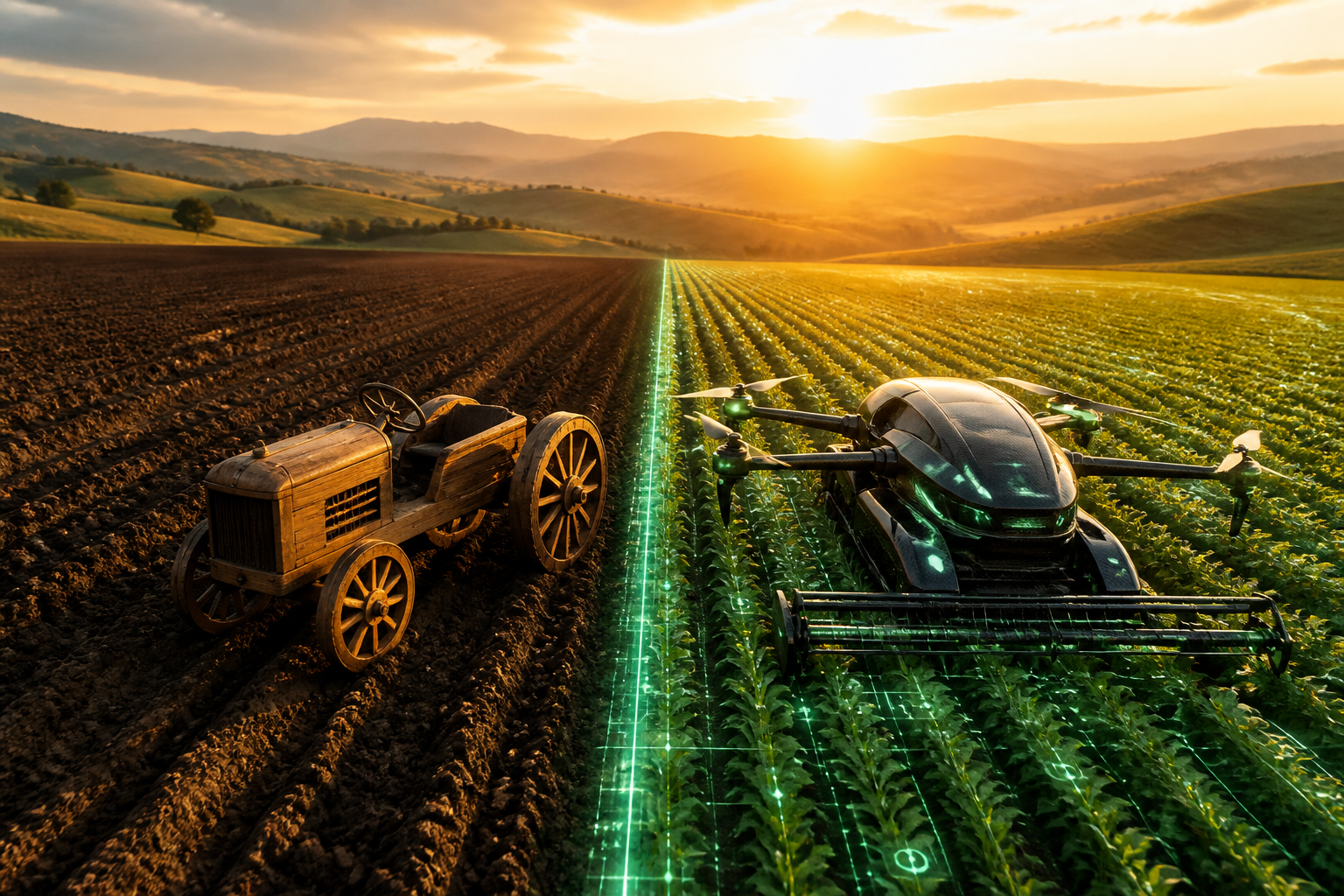
The Agrifood Divergence: Navigating Capital Gaps and Technological Disruption
Global agriculture faces a precarious K-shaped recovery. While APEC economies lean into artificial intelligence and blockchain to mitigate climate risks, a multi-billion dollar financing gap leaves smaller producers behind.
The global agrifood sector is currently navigating a period of profound structural realignment, characterized by a stark divergence between the rapid adoption of frontier technologies and a systemic failure to bridge the financing gap for mid-scale producers. As climate volatility, water scarcity, and energy price shocks exert unprecedented pressure on supply chains, the industry is witnessing a transition from traditional agrarian paradigms to a data-driven, bio-industrial model. This evolution, however, is not occurring uniformly. While sovereign entities and multinational conglomerates leverage blockchain and artificial intelligence to fortify resilience, billions of people continue to face food insecurity due to poorly targeted investments and a persistent capital void for loans ranging between twenty-five thousand and two million dollars. The resulting landscape is increasingly K-shaped, where a small cohort of technologically advanced enterprises thrives while the traditional backbone of global agriculture struggles to adapt to a rapidly changing ecological and regulatory environment.
The Geopolitics of Land Management and Regulatory Reform
Recent shifts in American land policy underscore the growing tension between environmental preservation and the imperative for agricultural expansion. The United States Department of Agriculture, under the guidance of Secretary Rollins, has moved to rescind Roadless Rule restrictions, a decision framed as a necessary measure to combat the escalating risk of wildfires and to support rural economic vitality. By opening millions of acres of national forest land to active management, the administration aims to facilitate infrastructure development that is essential for modern farming operations. This policy pivot is particularly significant in regions such as Georgia, where agricultural output remains a primary driver of the local economy. The removal of these barriers reflects a broader global trend where governments are increasingly prioritizing domestic production over strict conservationist mandates, often citing the need for greater national self-sufficiency in an era of fractured global trade. However, these moves frequently invite scrutiny from environmental advocacy groups, who argue that such deregulatory measures may lead to long-term habitat degradation and increased carbon emissions, thereby exacerbating the very climate risks they seek to mitigate.
The Financing Void and the Missing Middle
Despite the critical importance of agriculture to the global economy, the sector remains significantly under-capitalized, particularly at the level of small to medium-sized enterprises. Data from the Food and Agriculture Organization of the United Nations indicates that billions of dollars in potential productivity are lost each year because agrifood investments are either misaligned with local needs or perceived as too risky by traditional financial institutions. The most acute manifestation of this failure is the financing gap for loans between twenty-five thousand and two million dollars, a range that is too large for micro-finance providers and too small or high-risk for commercial banks. This missing middle prevents farmers from investing in the equipment, seeds, and irrigation systems necessary to scale their operations. Consequently, agricultural productivity in many developing regions remains stagnant, leaving populations vulnerable to price shocks and supply disruptions. Addressing this capital deficit requires a fundamental rethinking of blended finance models, where public guarantees and private equity work in tandem to de-risk agricultural lending and encourage a more equitable distribution of resources.
Technological Frontiers in the APEC Region
Across the Asia-Pacific region, the integration of advanced technologies is being hailed as the primary solution to the compounding crises of climate change and resource scarcity. During the APEC High-Level Public-Private Dialogue on Food Security held in Dalian, participants emphasized that the transition to a digital agricultural economy is no longer optional. The deployment of blockchain technology is being explored to enhance traceability and transparency in food supply chains, ensuring that products are sourced sustainably and reducing the prevalence of food fraud. Simultaneously, biotechnology and gene-editing are being utilized to develop crop varieties that are more resilient to drought and pests, a critical necessity as global temperatures continue to rise. Artificial intelligence is also playing a transformative role, with predictive analytics helping farmers to optimize water usage and fertilizer application. These innovations, while promising, raise significant questions regarding intellectual property rights and the digital divide. If the benefits of these technologies are concentrated solely within the most affluent economies, the global disparity in food security will only continue to widen.
The Erosion of Traditional Agrarian Influence
In the United Kingdom and Northern Ireland, the relationship between agricultural producers and the state is undergoing a period of intense friction. Agriculture Minister Andrew Muir has recently signaled a definitive shift in policy direction, suggesting that the era when farmers' unions could unilaterally dictate agricultural strategy is coming to an end. This hardening of the government position reflects a broader move towards prioritizing environmental outcomes and public goods over traditional production subsidies. As the government seeks to meet ambitious net-zero targets, farmers are being asked to pivot away from intensive livestock and arable farming towards practices that promote biodiversity and carbon sequestration. This transition has met with significant resistance from bodies such as the Ulster Farmers' Union, who argue that the new policy framework threatens the financial viability of family farms. The tension in Northern Ireland is symptomatic of a global trend where the socio-economic status of the farmer is being redefined, moving from a primary producer of food to a steward of the natural environment, a shift that requires not just new skills but an entirely different economic model.
Health Outcomes and the Re-Evaluation of Surpluses
For decades, the primary goal of global agriculture was the maximization of caloric output, a strategy that led to vast surpluses of staple crops such as corn, soy, and wheat. However, this focus on quantity over quality has contributed to a burgeoning public health crisis, particularly in developed economies. In the United States, the irony of rising food surpluses coinciding with declining national health metrics has prompted a rigorous re-evaluation of the American diet and the subsidies that support it. The prevalence of highly processed foods, derived from surplus commodities, is increasingly linked to chronic illnesses such as diabetes and cardiovascular disease. Critics argue that the current agricultural system is fundamentally misaligned with the nutritional needs of the population. This disconnect is driving a movement towards regenerative agriculture, which prioritizes soil health and nutrient density over sheer volume. By incentivizing the production of a more diverse range of fruits, vegetables, and ancient grains, policymakers could potentially reduce the long-term burden on healthcare systems while also fostering a more resilient and biodiverse agricultural landscape.
Labelling, Provenance, and the Protection of Domestic Markets
The importance of provenance in the global marketplace has never been higher, as consumers increasingly demand transparency regarding the origin of their food. The USDA has recently introduced new requirements for the Product of USA label, ensuring that only products derived from animals born, raised, slaughtered, and processed in the United States can carry the designation. This move is designed to protect domestic producers from the competitive pressures of imported goods that were previously able to use the label despite being processed in other countries. Similar trends are visible in the European Union and the United Kingdom, where geographical indication protections are being strengthened to safeguard the reputations of local delicacies. While these measures are popular with domestic agricultural lobbies, they can also be interpreted as a form of soft protectionism that complicates international trade negotiations. Furthermore, the rise of synthetic and lab-grown proteins presents a new challenge to traditional labelling conventions, forcing regulators to define what constitutes meat and how these new products should be marketed to a skeptical public.
Biological Threats and the Fragility of Global Chains
While digital and economic factors dominate the headlines, the agrifood sector remains deeply vulnerable to biological risks. The recent update regarding the New World Screwworm highlights the persistent threat posed by pests and diseases to livestock populations. An outbreak of such a parasite can have devastating consequences for animal welfare and agricultural exports, necessitating rapid and coordinated interventions from veterinary authorities. The globalized nature of modern food systems means that a biological threat in one region can quickly spread across borders, as seen in previous outbreaks of African Swine Fever and Avian Influenza. The management of these risks requires robust biosecurity protocols and international cooperation in surveillance and response. As climate change alters the habitats of various pests and pathogens, the frequency and severity of these biological threats are expected to increase, further complicating the task of ensuring global food security and maintaining the stability of agricultural markets.
A Forward-Looking Outlook on Systemic Resilience
The future of the global agrifood sector will be determined by its ability to resolve the contradictions inherent in its current growth model. The transition toward a more sustainable and technologically advanced system is inevitable, yet its success hinges on whether the benefits of innovation can be democratized. Policy interventions must focus on bridging the financing gap for mid-scale producers and ensuring that digital tools are accessible to those who need them most. Furthermore, the industry must move beyond the narrow focus on caloric yield to embrace a more holistic definition of productivity that includes nutritional quality and environmental stewardship. As the geopolitical landscape becomes increasingly fragmented, the resilience of food systems will depend on a combination of localized production and diversified international supply chains. The coming decade will likely see a continued consolidation of high-tech agricultural power, but the ultimate measure of progress will be the sector's ability to provide affordable, healthy, and sustainable food for a global population that is both growing and becoming increasingly urbanized. Failure to address the systemic inequities in capital and technology will not only destabilize the agricultural economy but will also pose a significant risk to global social and political stability.