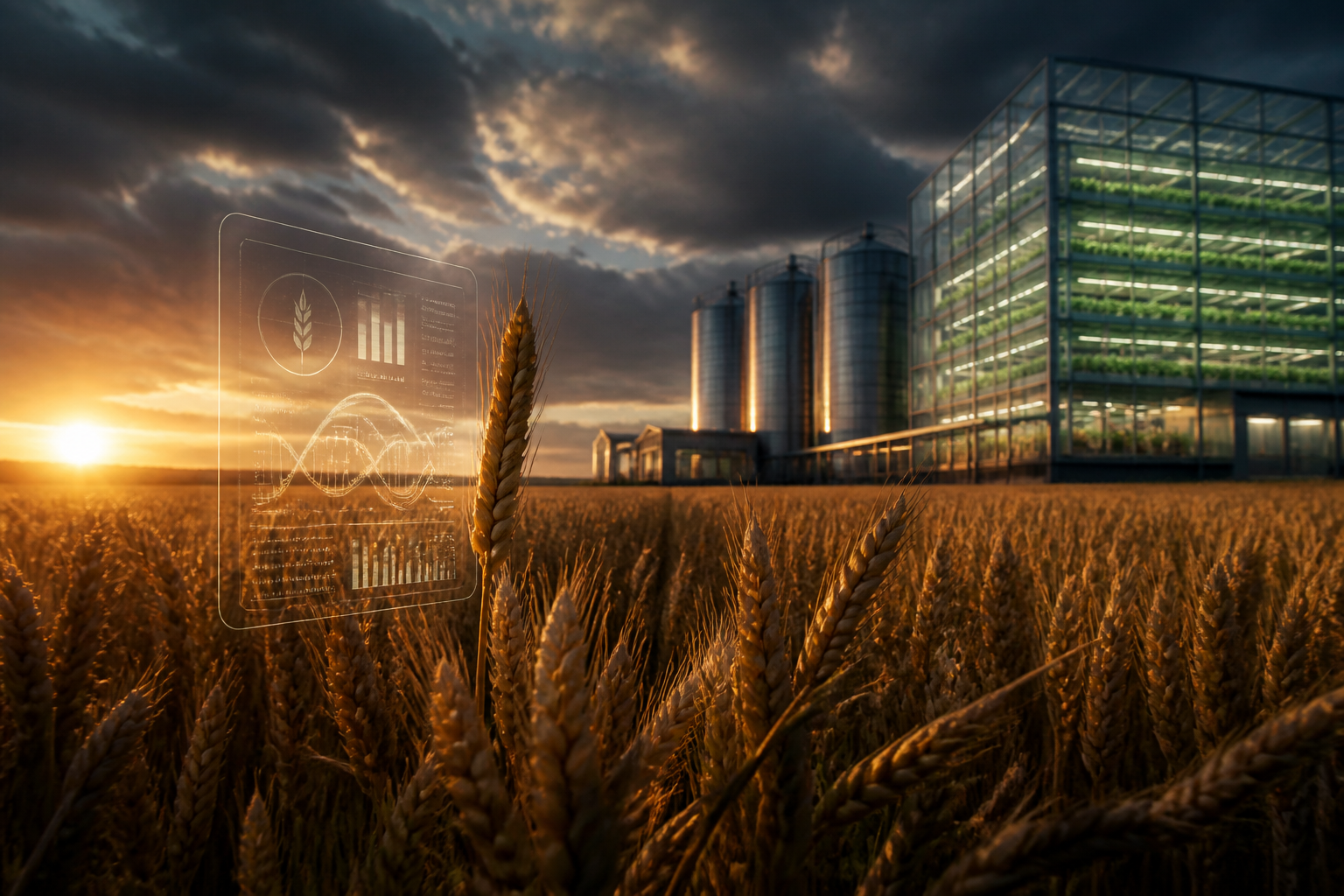
The Agrarian Renaissance: Technological Sovereignty and the Resilience of Global Food Chains
This editorial examines the intersection of agricultural biotechnology, data-driven resilience, and the circular economy. From South African biotech adoption to Canadian infrastructure investment, a new global map emerges.
The global agricultural landscape is currently navigating a period of profound structural realignment, driven by the dual imperatives of climate adaptation and macroeconomic volatility. While commodity markets for staples such as corn and soybeans have recently demonstrated a muted performance, finishing trading cycles with what analysts describe as a whimper, the underlying fundamentals of the sector are being transformed by a quiet revolution in technological application and resource management. This is no longer merely a question of yield maximization but rather a strategic pivot toward technological sovereignty and systemic resilience. From the vast grain belts of North America to the emerging biotech hubs of South Africa, the integration of high-fidelity data and circular industrial practices is creating a new hierarchy of agricultural power, where information is as critical a commodity as the crops themselves.
The Data Imperative and the Erosion of Uncertainty
In the contemporary agrifood sector, data has transcended its role as a supplementary tool for decision-making, becoming the very foundation of operational viability. The recent emphasis by international observers and innovators like ThriveAgric highlights a fundamental shift: data is no longer about simple record-keeping but about the creation of stronger, more resilient food systems that can withstand the exogenous shocks of the twenty-first century. By leveraging granular insights into soil health, moisture levels, and local micro-climates, producers are moving away from the broad-spectrum applications of the past toward a model of surgical precision. This transition is particularly evident in regions such as South Africa, where the rapid adoption of biotechnology is not merely an exercise in scientific curiosity but a pragmatic response to the need for economic opportunity in the face of environmental degradation.
This digitisation of the field allows for a reduction in the risk premiums that have historically plagued agricultural financing. When every input can be tracked and every output forecasted with a high degree of statistical confidence, the sector becomes more attractive to institutional capital. The transparency afforded by these digital systems enables a more sophisticated approach to business and marketing, as seen in the extension services provided by agencies such as the Vermont Agency of Agriculture. These institutions are increasingly focusing on the intersection of rural living and high-tech market strategies, ensuring that the benefits of the data revolution are not confined to large-scale corporate ventures but are disseminated throughout the rural economy to bolster local stability.
Market Fluctuations and the Commodity Paradox
Despite the long-term promise of technological integration, the immediate reality for grain producers remains tethered to the caprices of global market indices. Recent afternoon market recaps indicate a period of stagnation for corn and soybeans, reflecting a broader hesitation in the global supply chain as buyers weigh geopolitical risks against production surpluses in certain hemispheres. Conversely, winter wheat prices have shown a noticeable upward reversal, illustrating the fragmented nature of modern commodity trading. This divergence underscores the necessity for diversified agricultural portfolios that can absorb the impact of price troughs in one sector while capitalising on the peaks of another.
Institutions such as Agriculture and Agri-Food Canada have recognised this volatility and are responding with targeted investment programmes. The Poultry and Egg On-Farm Investment Program, for instance, represents a strategic move to fortify domestic supply chains against the erratic movements of international feed markets. By subsidising the modernization of on-farm infrastructure, the Canadian government is effectively hedging against future instability, ensuring that domestic producers can maintain margins even when global grain prices are unfavorable. This interventionist approach reflects a broader trend among G7 nations to treat food security not as a market outcome, but as a pillar of national security requiring sustained capital injection.
Biotechnology as a Catalyst for Economic Sovereignty
The adoption of advanced biotechnology serves as a critical differentiator in the emerging global agricultural order. In South Africa, the integration of genetically modified organisms and advanced breeding techniques has moved beyond the laboratory to become a cornerstone of the national economic strategy. These innovations are creating new economic opportunities by allowing for the cultivation of hardier varieties that require fewer chemical inputs and possess a greater tolerance for water scarcity. The resulting increase in productivity is not just a boon for food security; it provides a pathway for the primary sector to contribute more significantly to the gross domestic product of developing economies.
Furthermore, the application of biotech is not limited to terrestrial crops. The scientific community is increasingly looking toward the intersection of agriculture and marine biology to provide sustainable solutions for a growing global population. The Ministry of Agriculture, Food Security & New Growth Industries in various coastal regions has begun pioneering initiatives that teach communities how to repurpose materials once considered waste. A notable example is the conversion of fish skin into high-quality, sustainable leather. This represents a radical shift in how we define 'growth industries,' blending traditional agrarian skills with sophisticated biochemical processes to create high-value exports from materials that were previously environmental liabilities.
The Circular Agrifood Economy and Waste Valuisation
The transition toward a circular economy within the agrifood sector is perhaps the most significant structural change of the decade. By viewing agricultural output not as a linear path from field to fork, but as a closed-loop system, industry leaders are unlocking new revenue streams. The transformation of fish skin into sustainable products is emblematic of this broader trend toward waste valuisation. Such initiatives do more than just reduce the environmental footprint of the industry; they create localized manufacturing hubs that process raw materials on-site, thereby retaining a greater share of the value chain within the producing community.
This model of localized, high-value production is essential for revitalizing rural economies that have long suffered from the 'brain drain' of youth moving to urban centres. When agriculture is repositioned as a high-tech, circular industry, it attracts a new generation of entrepreneurs and researchers. Institutions like the Central Experimental Farm in Canada serve as blueprints for this integration, providing a space where urban populations can engage with the complexities of modern food production. This engagement is vital for building the social licence required for the large-scale implementation of new agricultural technologies and for fostering a public understanding of the economic necessity of supporting the primary sector.
Infrastructure and the Strategic Allocation of Capital
For the technological and circular revolutions to reach their full potential, they must be supported by robust physical and digital infrastructure. The AgriMarketing Program and similar initiatives are designed to bridge the gap between production and the global marketplace. However, the efficacy of these programs depends on the underlying strength of the farm-to-market logistics chain. Investments in modern storage facilities, reliable rural broadband, and automated processing plants are the silent enablers of the agrarian renaissance. Without these, the gains made through biotechnology and data analytics risk being lost to spoilage and logistical bottlenecks.
Governments are increasingly aware that the strategic allocation of capital must prioritise these invisible foundations. The shift toward poultry and egg investment in North America, for example, is as much about the hardware of production, ventilation systems, automated feeding, and climate-controlled housing, as it is about the livestock itself. These capital-intensive upgrades ensure that farms can operate at peak efficiency regardless of external weather conditions. In the long term, this infrastructure-first approach will be the deciding factor in which nations emerge as the dominant exporters of the mid-twenty-first century and which remain vulnerable to the vagaries of a changing climate.
A Forecast of Resilient Prosperity
Looking ahead, the agrifood sector is poised for a decade of divergence. Those regions and enterprises that embrace the synthesis of biotechnology, data-driven management, and circular production methods will likely experience a period of unprecedented growth and stability. We are moving toward an era where the definition of a 'farm' is expanding to encompass laboratories, data centres, and specialized manufacturing units. The traditional distinctions between agriculture and industry are blurring, giving rise to a sophisticated bio-economy that is both environmentally conscious and fiercely competitive.
However, this transition will not be without its challenges. The recent volatility in grain markets serves as a stark reminder that the primary sector remains subject to the laws of supply and demand, often exacerbated by geopolitical tensions. The key to navigating this future lies in the continued pursuit of technological sovereignty, the ability for producers to use advanced tools and data to insulate themselves from global shocks. As we look toward the 2030s, the nations that will lead the global agrifood market will be those that have successfully integrated their rural heartlands into the digital and circular economies, ensuring that the ancient practice of food production remains the most modern of all human endeavours.