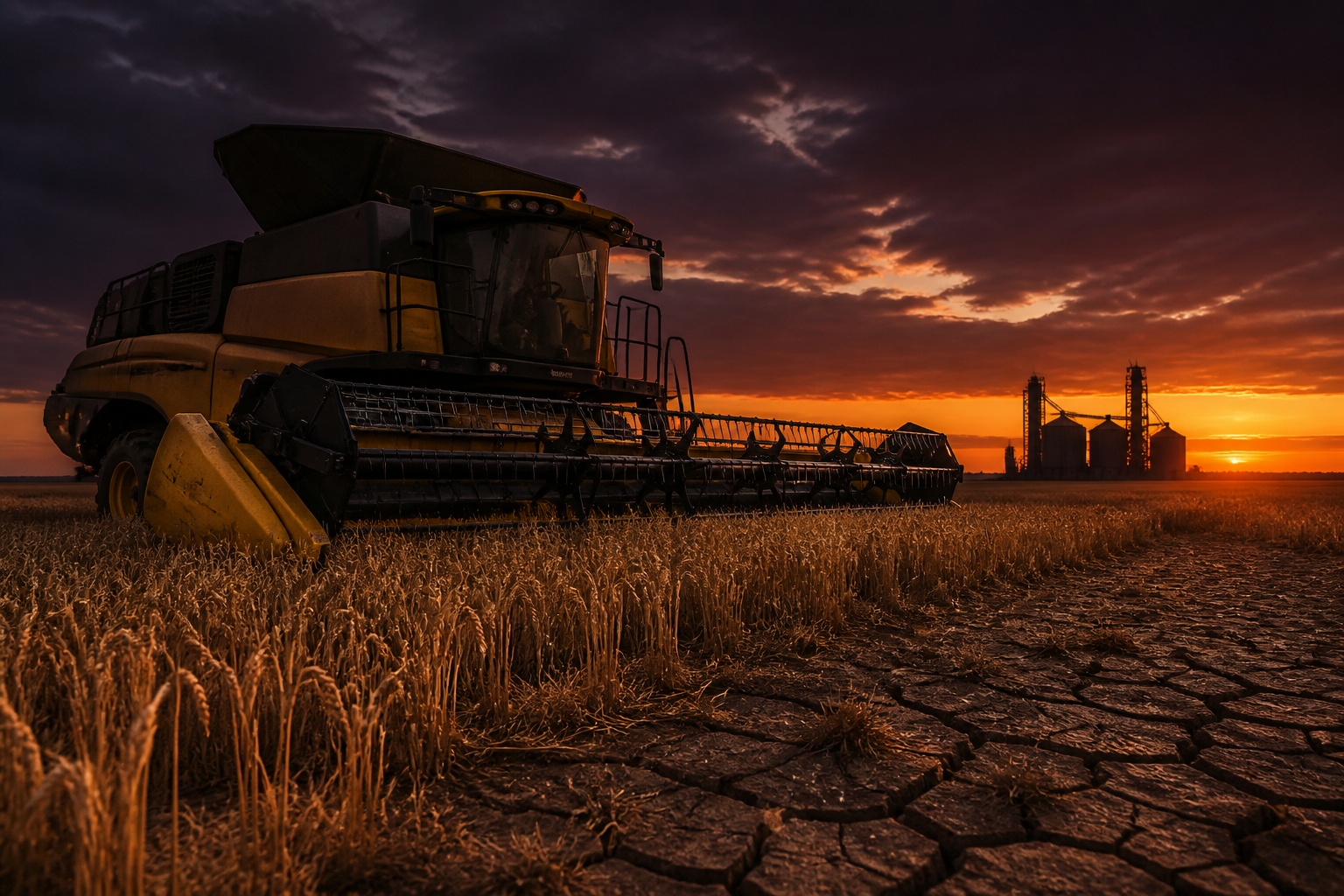
The Agrarian Contraction: Navigating Global Oversupply and Industrial Atrophy
A deep analysis of the current crisis in the global agrifood sector, examining the nexus of industrial layoffs at firms like John Deere, heightening trade tensions, and the urgent need for farmhouse management reform.
The global agricultural landscape is currently undergoing a profound and painful recalibration, as the post-pandemic euphoria of record commodity prices gives way to a sobering reality of oversupply and shrinking margins. For years, the sector was buoyed by a confluence of unusual factors: supply chain disruptions that inflated prices, significant government stimulus, and a singular focus on food security that prioritised volume over efficiency. However, the recent announcement of significant workforce reductions by primary equipment manufacturers signals that the cycle has decisively turned. When industrial bellwethers such as John Deere announce the redundancy of hundreds of skilled workers across their manufacturing hubs, it serves as a leading indicator of a deeper malaise within the rural economy. This is not merely a transient dip in demand but rather a structural signal that the capital-intensive model of modern farming is hitting a ceiling of affordability, compounded by a sluggish global economy that has dampened the appetite for luxury machinery and high-cap investment.
The Industrial Retrenchment of Machinery Giants
The most visible manifestation of the current agrarian cooling is found in the heart of the manufacturing sector. As reports circulate regarding the cutting of approximately 170 jobs across major agricultural equipment firms, with John Deere alone accounting for a significant portion of these losses, the industrial foundations of the sector are visibly quivering. These layoffs are not isolated incidents but represent a strategic retreat in the face of slumping sales globally. During the period of high commodity prices, farmers across the American Midwest, the Canadian prairies, and Western Europe invested heavily in precision technology and high-horsepower machinery. Today, with interest rates remaining stubbornly elevated and the cost of debt service weighing heavily on farm balance sheets, that investment cycle has stalled. The stagnation is reflective of a broader economic inertia; when the primary producers stop buying, the impact ripples through the supply chain, affecting everything from steel fabrication to software development in the AgTech space.
Geopolitical Tensions and the Fragility of Trade
Agricultural trade remains a vital artery for global livelihoods, yet it is currently under threat from an increasingly protectionist geopolitical environment. The Organisation for Economic Co-operation and Development (OECD) has frequently highlighted how trade supports the entire agri-food supply chain, yet we are witnessing a divergence in policy that threatens this equilibrium. In North America, the United States Department of Agriculture (USDA) continues to champion its role as a global leader in food security, but this leadership is being tested by shifting trade corridors. The weaponisation of food exports and the imposition of retaliatory tariffs have made international markets more volatile than at any point in the last three decades. For the individual farmer, this means the traditional certainty of the export market is being replaced by a precarious dependence on bilateral agreements that can be rescinded at a moment's notice. The resilience of the sector now depends less on the volume of production and more on the diversity of market access, a transition that requires significant diplomatic and logistical agility.
The Scottish Model and the Professionalisation of the Farmhouse
Inland from the high-level trade disputes, a quiet revolution in management is being advocated within the United Kingdom. Recently, Scottish Land & Estates has called for rural businesses to be placed at the very centre of Scotland’s economic growth strategy. This movement argues for a shift in focus from mere production to sophisticated business planning and benchmarking. The report underscores a critical truth: the most successful farms in the coming decade will be those that adopt the traits of high-performing corporate entities. This includes rigorous on-farm management improvements, the adoption of data-driven decision-making, and a move away from traditional subsidy dependence. By encouraging farms to operate as lean, professional businesses, the sector can better insulate itself against the price fluctuations of the global commodities market. This professionalisation is not about erasing the heritage of the land but about ensuring the financial viability of that heritage in an era where the margin for error has narrowed to almost zero.
Climate Resilience and the Cost of Intervention
The environmental reality of modern farming continues to demand significant state intervention, as evidenced by recent initiatives in Canada. Agriculture and Agri-Food Canada has been forced to deploy the AgriRecovery Initiative to support those affected by severe drought, alongside a substantial joint investment with Ontario to strengthen farm security. These interventions, while necessary, highlight the increasing fiscal burden of maintaining food systems in a volatile climate. The $12 million investment in Ontario is a microcosm of a global trend: the necessity of the state to underwrite the risks that private insurance markets are increasingly unwilling to cover. However, the reliance on emergency funding is a double-edged sword. While it prevents immediate bankruptcy, it can often delay the necessary structural adaptations required to manage water scarcity or temperature shifts. The long-term sustainability of the sector will require a move away from reactive bailouts towards proactive investment in resilient infrastructure and drought-resistant biological assets.
The Paradox of Global Food Security
Despite the industrial layoffs and trade frictions, the imperative of global food security remains the primary driver of agricultural policy. The USDA maintains that the United States must remain a leader in this arena to foster economic growth, yet the disconnect between high-level policy goals and the reality on the ground is stark. We are currently observing a paradox: while global institutions warn of impending food shortages in developing regions, producers in developed nations are struggling with a glut of supply that is driving down prices. This imbalance points to a failure of distribution and market efficiency rather than a failure of production capacity. The challenge for the next five years is not necessarily how to grow more, but how to move products more effectively across borders that are becoming increasingly difficult to navigate. The role of the agri-food supply chain is being redefined from a simple delivery mechanism to a complex system of risk management and strategic stockpiling.
A Strategic Outlook for the Decisive Decade
As we look toward the latter half of the 2020s, the agricultural sector must prepare for a period of sustained austerity. The era of cheap credit and rapid expansion is over. The coming years will be defined by 'precision survival', a strategy where firms and individual producers alike must ruthlessly prune inefficiencies. We should expect to see further consolidation among equipment manufacturers as they seek to achieve economies of scale in a shrinking market. Conversely, at the farm level, we may see a fragmentation of traditional models, with a rise in boutique, high-value production existing alongside massive, automated industrial operations. The winners in this new landscape will be those who can integrate the professional management practices advocated in the Scottish report with the technological innovations that are still emerging from the AgTech sector. Ultimately, the crisis of 2024 is a catalyst for a long-overdue transformation. The industry is moving away from the brute force of mechanical expansion toward a nuanced, data-centric, and commercially rigorous future. While the transition will undoubtedly be marked by further job losses and economic displacement, the result will be a more resilient, albeit leaner, global agrifood system capable of withstanding the geopolitical and environmental shocks of the mid-21st century.