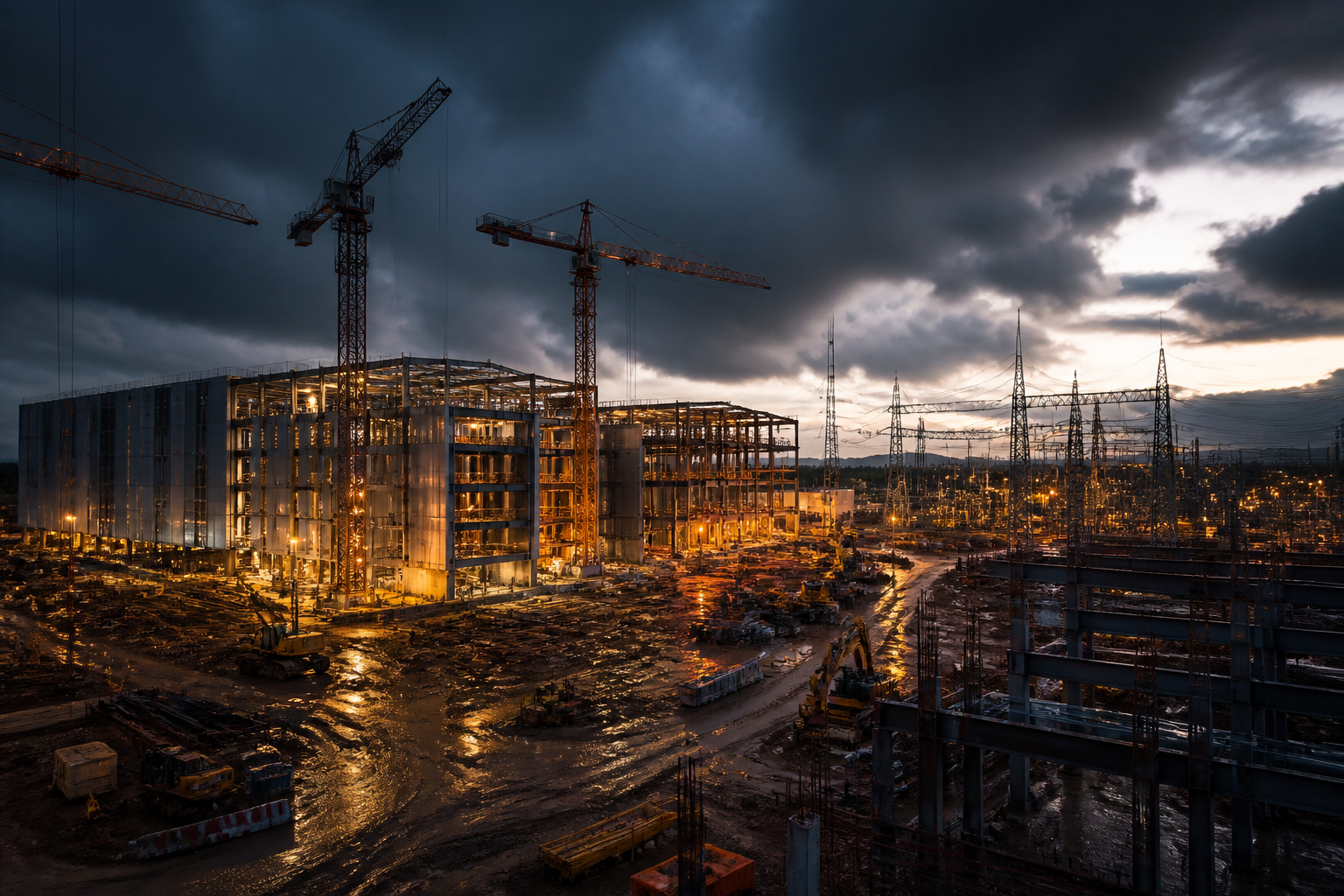
The Heavy Toll Of Modernity: Capital Costs And The Artificial Intelligence Infrastructure Pivot
A deep analysis of how the massive capital requirements for AI data centres and power grids are colliding with a high-interest-rate environment, forcing a radical rethink of public and private infrastructure financing.
The global economic architecture is currently navigating a period of profound structural tension, as the insatiable capital demands of the artificial intelligence revolution collide with a macroeconomic environment defined by persistent inflationary pressures and tightening monetary policy. For much of the past two years, the narrative surrounding the fourth industrial revolution focused on the prowess of large language models and the valuation of semiconductor giants, yet the reality of this transition is increasingly anchored in the physical world of steel, concrete, and high-voltage transmission. As the BlackRock Investment Institute recently observed, the scale of financing required for the artificial intelligence buildout is adding significant pressure to already elevated government borrowing needs, effectively tethering the digital future to the fiscal constraints of the present. This convergence of interests, where the energy-intensive requirements of data processing meet the urgent need for grid modernisation, is creating a new paradigm for infrastructure investment that favours scale and resilience over the speculative agility of the previous decade.
The Monetary Constraint And The Cost Of Capital
Central to this shift is the transition into what economists frequently describe as the five percent world, a reference to the sustained high interest rates that have replaced the era of cheap liquidity. The Bank of Japan has recently joined the trend of tightening monetary policy, marking a definitive end to the global experiment with negative interest rates and creating a new floor for the cost of borrowing. For infrastructure projects, which are traditionally capital-intensive and sensitive to the cost of debt, this new environment demands a rigorous reassessment of viability. The elevated prices of refined energy products, which have remained high relative to crude oil benchmarks, further complicate the operational expenditure for major projects. In this context, the funding gap between public ambition and private capability is widening, necessitating more sophisticated public-private partnerships. The Deloitte Insights report for late September 2026 underscores that while headline inflation may be cooling in certain sectors, the structural costs of building and maintaining physical assets remain stubbornly high, placing a premium on efficiency and strategic location.
The Regional Pivot Towards Strategic Hubs
Amidst these global headwinds, a significant movement is occurring at the sub-national level, where local authorities are aggressively pursuing infrastructure as a lever for economic survival. In the United States, regions such as Hidalgo County have formalised economic development programmes that prioritise infrastructure as the primary catalyst for growth. This is not merely a localized phenomenon, but a reflection of a broader trend where secondary and tertiary markets are positioning themselves as vital nodes in the global supply chain. Similarly, Louisiana Economic Development has finalised substantial investments in the FastSites programme, specifically targeting ports in Alexandria and Natchitoches Parish. By investing more than four point five million dollars to expand manufacturing and warehousing capacity at these ports, the state is attempting to capture the shifts in global trade routes. These investments suggest that even in a high-interest environment, the strategic value of logistics hubs remains high, provided they can offer the necessary connectivity to international markets.
Data Centres And The Energy Imperative
Perhaps the most transformative force in the current infrastructure landscape is the expansion of data centres. These facilities are no longer peripheral utility buildings but have become the central nervous system of the modern economy. The scale of their energy consumption is forcing a total re-evaluation of national energy grids. The BlackRock analysis highlights that the unprecedented financing needs for this buildout are driving up government borrowing requirements, as the public sector is often tasked with providing the underlying power infrastructure to support these private investments. The challenge is twofold, as developers must secure not only the capital to build the facilities but also the long-term energy contracts to power them. This has led to a resurgence of interest in nuclear power and advanced grid management systems, as the intermittent nature of renewable energy often fails to meet the constant, high-load requirements of intensive artificial intelligence processing. The resulting pressure on the grid is a significant concern for policymakers who must balance industrial growth with the energy security of the general population.
Urban Renewal And The Infrastructure Of Inclusion
While high-technology hubs attract the lion's share of headlines, the revitalisation of older industrial centres remains a critical component of the infrastructure narrative. In cities such as Steubenville, leaders are reporting a wave of new business activity and infrastructure investment aimed at reversing decades of population decline. This form of development is less about the cutting-edge digital frontier and more about the fundamental restoration of civic viability. By upgrading water systems, roads, and local transport links, these municipalities are attempting to create the conditions necessary for small-scale commercial growth. The mayor of Steubenville has noted that these foundational investments are essential for attracting the human capital required to sustain a modern economy. This highlights a critical lesson for the broader infrastructure sector, that the most successful projects are those that integrate physical improvements with socio-economic objectives, ensuring that the benefits of investment are distributed beyond the immediate technological elite.
Institutional Finance And The Shift To Private Markets
As public balance sheets become increasingly strained by the dual pressures of debt servicing and social spending, the role of institutional investors in the infrastructure space has become more prominent. Sovereign wealth funds, pension funds, and private equity firms are stepping in to fill the financing void, drawn by the inflation-hedging characteristics of real assets. However, the nature of these investments is changing. There is a growing preference for brownfield projects where existing cash flows can mitigate the risks associated with high construction costs. The BlackRock Investment Institute notes that the sheer scale of the artificial intelligence buildout is creating new asset classes within the infrastructure sector, ranging from specialized cooling systems to dedicated fibre-optic networks. This institutionalisation of infrastructure as a private asset class provides a necessary source of liquidity, but it also raises questions about the long-term governance of essential services and the potential for increased costs to be passed on to the end-consumer.
Forward Looking Outlook On Global Resilience
Looking ahead, the infrastructure sector will likely be defined by a period of intense selective investment. The broad, indiscriminate spending of the low-interest-rate era is over, replaced by a more disciplined approach that prioritises projects with clear strategic or technological advantages. The interaction between the digital economy and the physical grid will remain the primary driver of capital flows, potentially leading to a new geography of industry where access to reliable, low-cost power is the most valuable commodity. We expect to see a further consolidation of infrastructure assets among large institutional players who have the scale to manage complex, multi-decade projects. Simultaneously, the success of regional development programmes, such as those seen in Louisiana and Texas, will depend on their ability to integrate into global value chains while maintaining fiscal discipline. The coming decade will test the resilience of the global infrastructure framework, as it attempts to accommodate the vast requirements of the artificial intelligence age within a world of finite resources and expensive capital. Only those nations and regions that can successfully navigate these competing pressures will emerge as the new leaders of the global economy.