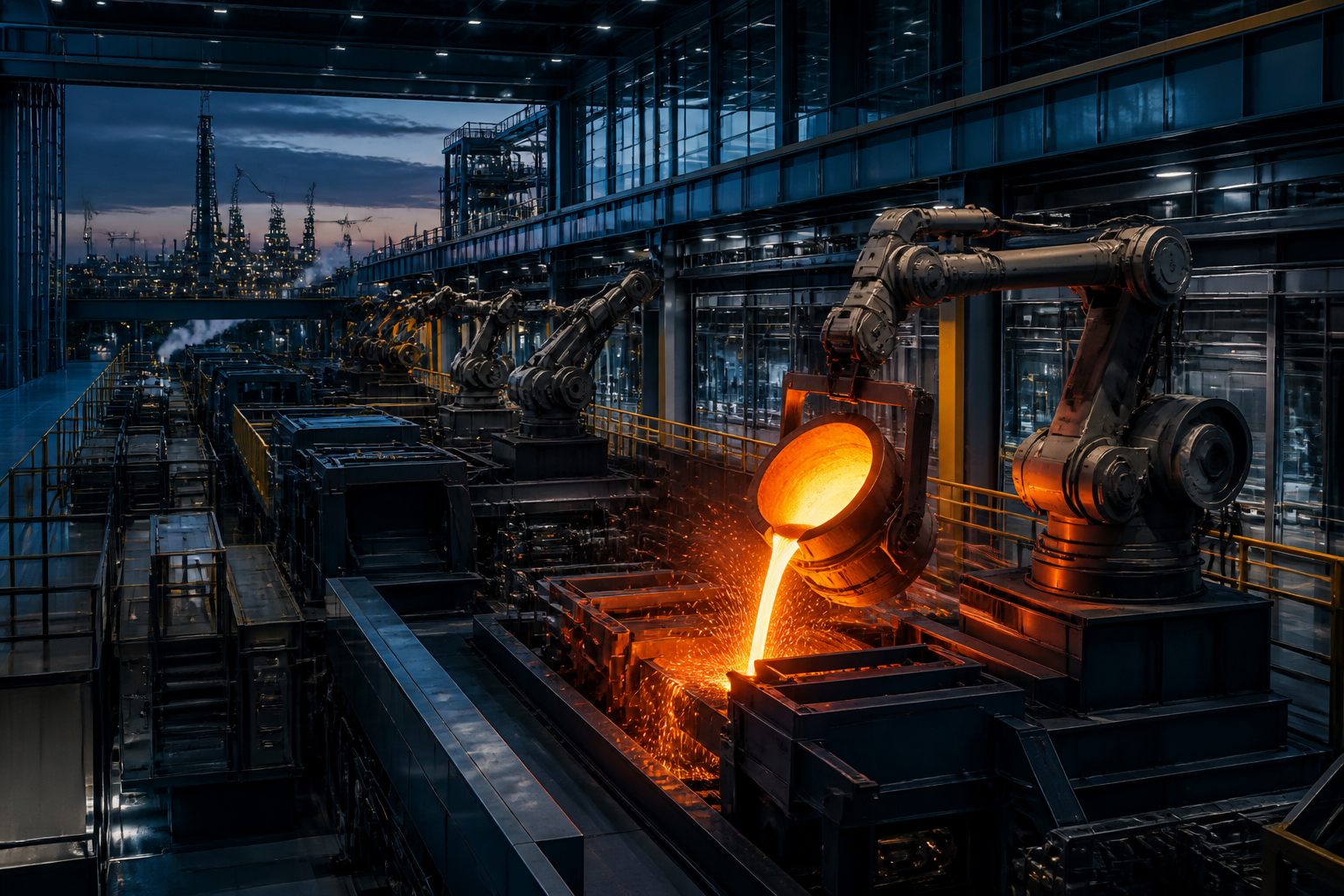
Stagnation or Structural Shift: The Precarious Evolution of Global Industrial Capacity
A deep analysis of the contemporary industrial landscape, examining how central bank policies, trade realignment in Cuba and the Middle East, and technological disruptions are reshaping the global manufacturing order.
The global industrial complex currently stands at a historical inflection point where the post-pandemic recovery era concludes and a more fragmented, technologically intensive epoch begins. As central banks, including the Federal Reserve and the European Central Bank, navigate a delicate 'higher-for-longer' interest rate environment, the capital-intensive nature of heavy industry is undergoing a rigorous stress test. Investors and analysts, closely monitoring the economic calendars provided by institutions such as Yahoo Finance/Kiplinger, are particularly attuned to upcoming inflation data which will dictate the cost of credit for the next fiscal year. However, the narrative of 2024 is not merely one of monetary constraints; it is a story of profound structural realignment. From the radical market liberalisation witnessed in Cuba to the increasing assertiveness of Iranian economic strategy, the traditional maps of global trade are being redrawn. This shifts the focus from simple supply chain efficiency to a new doctrine of resilience and strategic autonomy, a transition that demands a sophisticated understanding of both geopolitical risk and the accelerating pace of technological integration.
The Monetary Weight on Industrial Expansion
The industrial sector’s health has historically served as a bellwether for the broader economy, yet the current data presents a paradox of resilience amidst tightening. Recent reports from Deloitte Insights suggest that while the primary shock of inflation has subsided, the secondary effects, namely the sustained high cost of borrowing, are curbing long-term capital expenditure. For multinational giants in the aerospace and automotive sectors, the cost of financing new production facilities has nearly doubled in real terms over a thirty-six-month period. This has led to a strategic pivot: rather than pursuing aggressive brownfield expansion, firms are increasingly focusing on brownfield optimisation. The fiscal discipline imposed by the current interest rate cycle is forcing a level of operational efficiency that was perhaps overlooked during the era of 'easy money.' Companies are now required to justify every percentage point of capacity expansion against a backdrop of a cooling global demand curve, particularly in Europe where energy costs remain a volatile variable.
Furthermore, the anticipation of key inflation updates, such as the Personal Consumption Expenditures (PCE) price index, creates a climate of suspended animation for industrial planners. Should these figures show a stubborn persistence in core prices, the likelihood of a pivot toward rate cuts diminishes, potentially suffocating the nascent recovery in global purchasing managers' indices (PMIs). The industrial sector cannot operate in a vacuum of uncertainty; it requires the predictable cost of capital to commit to the multi-decadal projects that underpin global infrastructure. Without this stability, we risk a period of 'capital starvation' in essential industries, which could lead to supply-side bottlenecks in the coming decade, ironically re-igniting the very inflation that central banks are currently attempting to extinguish.
Geopolitical Flux and the New Market Frontiers
While the Western world grapples with the mechanics of disinflation, other regions are undergoing seismic shifts in economic philosophy. Perhaps the most striking example is the Republic of Cuba, which has recently embarked on its most significant free-market reforms since the 1959 Revolution. By loosening state control over enterprises and encouraging private investment, the Caribbean nation is attempting to integrate into the global industrial fold after decades of relative isolation. This is not a isolated phenomenon; it represents a broader trend of 'frontier market' liberalisation as nations seek to hedge against the volatility of major power competition. For global industrial observers, these shifts represent both an opportunity and a cautionary tale regarding the speed at which state-managed economies can pivot toward market-driven structures.
Simultaneously, the Middle East is asserting a newfound economic confidence that goes beyond its traditional hydrocarbons dominance. Iran’s strategic positioning, as noted by contemporary analysts, suggests a nation pressing its advantage through regional trade blocks and bilateral industrial agreements. The tension between this rising regional assertiveness and the established Western-led order is creating a fragmented landscape for logistics and maritime trade. Industrial firms must now account for 'geopolitical premiums', the additional costs associated with rerouting shipping, securing diversified sources of raw materials, and navigating a labyrinth of evolving sanctions. The era of the truly 'global' supply chain is being replaced by a 'multi-nodal' system, where regional security is as critical a factor as manufacturing labour costs.
Technological Autonomy and the Race for the Future
The fourth industrial revolution, often simplified as 'Industry 4.0', has transitioned from a prospective concept to a competitive necessity. As CNN Business and other major outlets report, the innovations driving top companies today are no longer secondary to their physical output; rather, they are the primary drivers of value. The integration of advanced artificial intelligence into manufacturing processes is no longer about simple automation, but about predictive maintenance and the creation of digital twins that allow for real-time stress testing of global production networks. This technological surge is not evenly distributed, creating a new 'digital divide' in industrial capacity. Nations and corporations that can successfully integrate these technologies are seeing a decoupling of productivity from traditional labour inputs, allowing for 'near-shoring' to become a viable economic reality.
This shift toward technological autonomy is particularly evident in the semiconductor and green energy sectors. As governments in the United States and the European Union provide massive subsidies for domestic chip fabrication and battery production, the industrial landscape is becoming increasingly politicised. The 'industrial policy' that was once dismissed by proponents of the Washington Consensus has returned with a vengeance. These subsidies are intended to insulate domestic industries from the vulnerabilities of global supply chains, but they also risk creating inefficiencies and trade disputes. The challenge for the coming years will be to balance the need for strategic domestic capacity with the undeniable efficiencies of global trade, all while ensuring that the pace of innovation does not outstrip the regulatory frameworks designed to govern it.
The Energy Transition as an Industrial Catalyst
No discussion of modern industry is complete without addressing the total transformation required by the transition to a low-carbon economy. This is not merely an environmental imperative but the single largest industrial undertaking in human history. The realignment of the global energy grid away from fossil fuels requires an unprecedented volume of raw materials, lithium, cobalt, copper, and rare earth elements, which are becoming the new 'oil' of the 21st century. Industrial firms are finding themselves at the centre of this scramble for resources, often having to integrate vertically to secure their future production lines. This has sparked a new wave of industrial diplomacy, as Western firms compete with their Chinese counterparts for mining rights and processing infrastructure in Africa and Latin America.
Moreover, the decarbonisation of heavy industries such as steel and cement is proving to be a formidable technical challenge. The 'green premium' on these essential materials remains high, and yet, the regulatory pressure to reduce Scope 3 emissions is intensifying. We are seeing the emergence of 'Green Industrial Zones,' where co-located renewable energy sources provide the power for zero-emission manufacturing. This is not只是 a shift in power sources; it is a shift in industrial geography. Regions with high renewable energy potential are becoming the new hubs of heavy industry, potentially displacing the traditional coal-and-iron heartlands of the 20th century. The winners of this transition will be those who can bridge the gap between heavy industrial output and environmental sustainability without compromising on cost-competitiveness.
Labour Dynamics and the Reskilling Mandate
As the industrial sector becomes more capital and technology-intensive, the nature of the industrial workforce is undergoing a profound mutation. The 'blue-collar' worker of the past is being replaced by the 'new-collar' technician, individuals who possess a blend of traditional vocational skills and advanced digital literacy. However, there is a mounting crisis in labour supply. Educational institutions have largely failed to keep pace with the evolving demands of modern manufacturing, leading to a chronic skills gap that threatens to stall industrial expansion in developed economies. Firms such as Siemens and Rolls-Royce are increasingly taking education into their own hands, launching internal academies to cultivate the specific expertise they require.
This labour shortage is not just a demographic issue; it is a competition for talent. The tech sector has historically drained the brightest minds away from traditional industry, but the narrative is beginning to change. As the 'physical world' becomes more integrated with the 'digital world,' the prestige associated with complex industrial engineering is returning. To attract the next generation of engineers, the industrial sector must rebrand itself as the vanguard of a high-tech, sustainable future. This requires a cultural shift within the industry itself, moving away from the hierarchical structures of the past toward more agile, innovation-driven environments. The future of industrial power resides in the ability to marry human ingenuity with machine precision, and the nations that solve the skills puzzle first will gain a definitive competitive advantage.
Forward-Looking Outlook: Navigating the New Normal
As we peer into the middle of the decade, the industrial sector appears resilient but fragile. The immediate future will be defined by a 'cleansing' effect, where the high cost of capital eliminates inefficient actors and rewards those who have prioritised technological integration and supply chain diversification. We expect to see a period of intense consolidation, as larger firms with robust balance sheets acquire the niche technology providers essential for their digital transformation. The geopolitical landscape will remain volatile, with 'friend-shoring' becoming the standard operating procedure for critical industries. However, this fragmentation should not be mistaken for a permanent retreat from globalism. Instead, it is a maturation, a move toward a more conscious and strategic form of global integration.
In the long term, the success of the global industrial complex will depend on its ability to navigate the transition to a circular economy. The linear 'take-make-dispose' model is reaching its environmental and physical limits. The next frontier for industry will be the massive scaling of recycling technologies and the design of products for infinite lifecycles. This will require a level of cross-sector collaboration that is currently in its infancy. For the astute investor and the strategic policy-maker, the message is clear: the future belongs to those who view industrial capacity not as a fixed asset to be managed, but as a dynamic, evolving ecosystem that must be continuously reinvented to thrive in an era of unprecedented change.