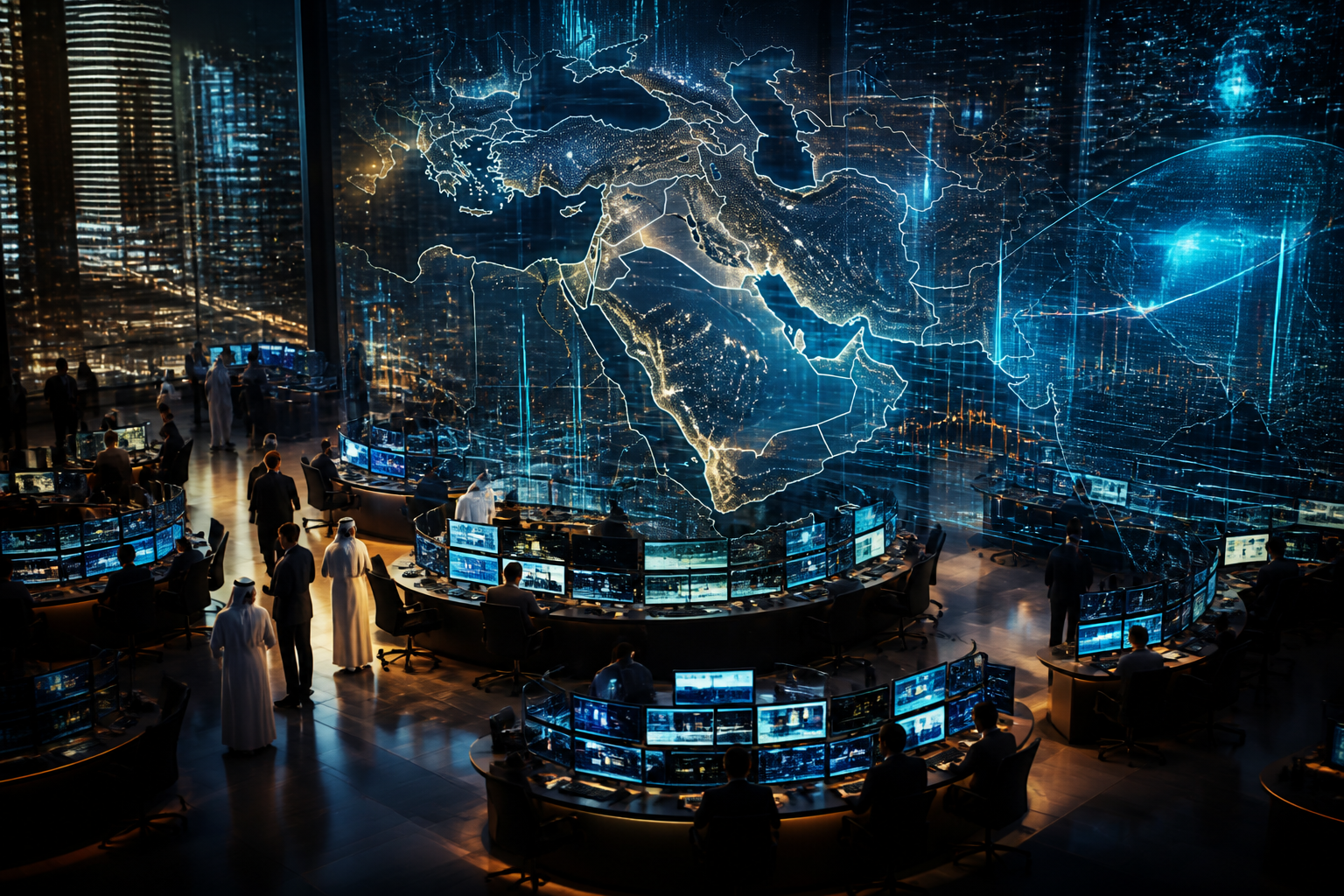
The Resilience Of Capital: Navigating Geopolitical Fractures In The Energy Paradigm
A deep analysis of global market resilience amidst U.S.-Iran tensions. We examine the burgeoning alliance between Washington and Abu Dhabi, the influence of technological titans, and the shift in private equity strategy.
The global industrial complex is currently undergoing a profound stress test, navigating a labyrinth of geopolitical hostility and fluctuating energy valuations that would, in previous decades, have precipitated a systemic collapse. Despite the shadow of conflict looming over the Persian Gulf and the persistent rhetoric of a U.S.-Iran confrontation, international markets have demonstrated a defiance that borders on the extraordinary. This resilience is not merely a product of optimistic speculation but is rooted in a fundamental shift in how capital perceives risk and how institutional actors, from the Federal Reserve to the sovereign wealth funds of the United Arab Emirates, are recalibrating their long-term trajectories. The convergence of energy security, technological hegemony, and a restructured private equity landscape suggests that we are entering an era where geopolitical volatility is no longer an external shock, but a calculated variable within the mechanisms of global finance.
The Strategic Consolidation Of American And Emirati Interests
One of the most consequential developments in the current geopolitical theatre is the deepening of the strategic partnership between the United States and the United Arab Emirates. While traditional alliances have often been predicated on the simple exchange of security for crude oil, the contemporary relationship has evolved into a sophisticated technological and financial axis. Abu Dhabi’s proactive stance in aligning with American interests during periods of heightened tension with Iran serves as a stabilisation mechanism for global energy logistics. This bond has been further cemented by the necessity of price stability, an objective shared by the Federal Reserve and the UAE’s leadership. By positioning itself as a reliable mediator and a primary destination for Western capital, the UAE is effectively insulated against the broader contagions of regional conflict, ensuring that the flow of commerce through the Strait of Hormuz remains incentivised by mutual profit rather than governed by military posturing.
Energy Volatility And The Inflationary Narrative
The persistence of inflationary anxieties continues to haunt the deliberations of central bankers, yet the anticipated surge in oil prices following regional skirmishes has been notably tempered. This phenomenon can be attributed to the diversified nature of modern energy production and the strategic deployment of national reserves. When U.S.-Iran negotiations show signs of progress, or even when they plateau into a stagnant but predictable hostility, the markets tend to focus on the underlying macroeconomic indicators rather than the immediate cycle of a news bulletin. The easing of inflation angst is not a sign of total recovery but rather a recognition that the global supply chain has developed more robust adaptive measures since the shocks of the early 2020s. Institutions are no longer pricing in a total cessation of Middle Eastern exports, but are instead focused on the marginal shifts in production capacity and the capacity of the United States to act as a swing producer.
The Technocratic Ascendancy And Market Sovereignty
A critical component of this new industrial era is the disproportionate influence of a few select corporate entities and their orchestrators. Figures such as Elon Musk and companies like Intel have become geopolitical actors in their own right, moving markets with a degree of velocity that often surpasses legislative action. The recent surge in Intel’s valuation, bolstered by critical partnerships with Apple, illustrates the central role of hardware in the modern security apparatus. As Alan Kohler has observed in his long-term study of financial cycles, the control of the economy has shifted toward those who command the infrastructure of technology. This technological hegemony provides a secondary layer of market insulation; even as energy prices fluctuate, the demand for high-end semiconductors and artificial intelligence architecture remains inelastic, providing a foundation of growth that transcends the traditional oil-indexed economy.
Private Equity And The Reconfiguration Of Consumer Markets
While the macro-narrative is dominated by states and silicon, a quieter but equally significant revolution is occurring within the private equity sector. The penetration of private capital into consumer services, ranging from fitness centres to quick-service restaurant chains, reveals a shift toward defensive, cash-flow-heavy assets. This is evident in the strategic ownership of brands such as Guzman y Gomez and Betty’s Burgers, where private equity firms are leveraging operational efficiencies to extract value in a high-interest-rate environment. The experimentation with new business models, such as integrating specialised nutritional offerings within gymnasium environments, reflects an attempt to find growth in fragmented domestic markets at a time when international industrial expansion is fraught with geopolitical peril. This trend highlights a bifurcation in the investment world: a pursuit of high-stakes technological dominance on one hand, and a retreat into the predictable margins of domesticated consumer habits on the other.
The Federal Reserve And The Mandate Of Stability
Central to the maintenance of current market resilience is the Federal Reserve’s unwavering commitment to price stability. Every Chair’s tenure is defined by this promise, yet the current environment demands a more nuanced approach than simple rate adjustments. The Fed must now account for the inflationary impact of de-globalisation and the costs associated with the 'friend-shoring' of supply chains. As the United States navigates its complex relationship with Iranian authorities, the Fed’s ability to signal long-term stability is what prevents regional conflicts from triggering a global recessionary spiral. The resilience highlighted by analysts like Joe Moglia is a testament to the fact that the financial system has, over decades of crisis, developed a higher threshold for geopolitical noise, provided that the central banking core remains transparent and predictable in its quest to curb runaway inflation.
Forward Outlook: A New Geopolitical Equilibrium
Looking toward the near future, the industrial landscape will likely be defined by a state of 'contained volatility.' The markets have demonstrated that they can withstand a considerable degree of regional instability without descending into a panic, provided that the underlying conduits of technology and financial cooperation remain intact. We should expect a further deepening of the tech-industrial complex, where corporations play a larger role in diplomatic outcomes, and where energy security is increasingly viewed through the lens of technological innovation rather than just resource extraction. Investors must prepare for a world where the 'war premium' on commodities is permanently integrated into pricing models, but compensated for by the rapid growth of the digital infrastructure. The era of the simple commodity shock is over; in its place is a more complex, resilient, and interconnected system that thrives on its ability to price in the unpredictable.