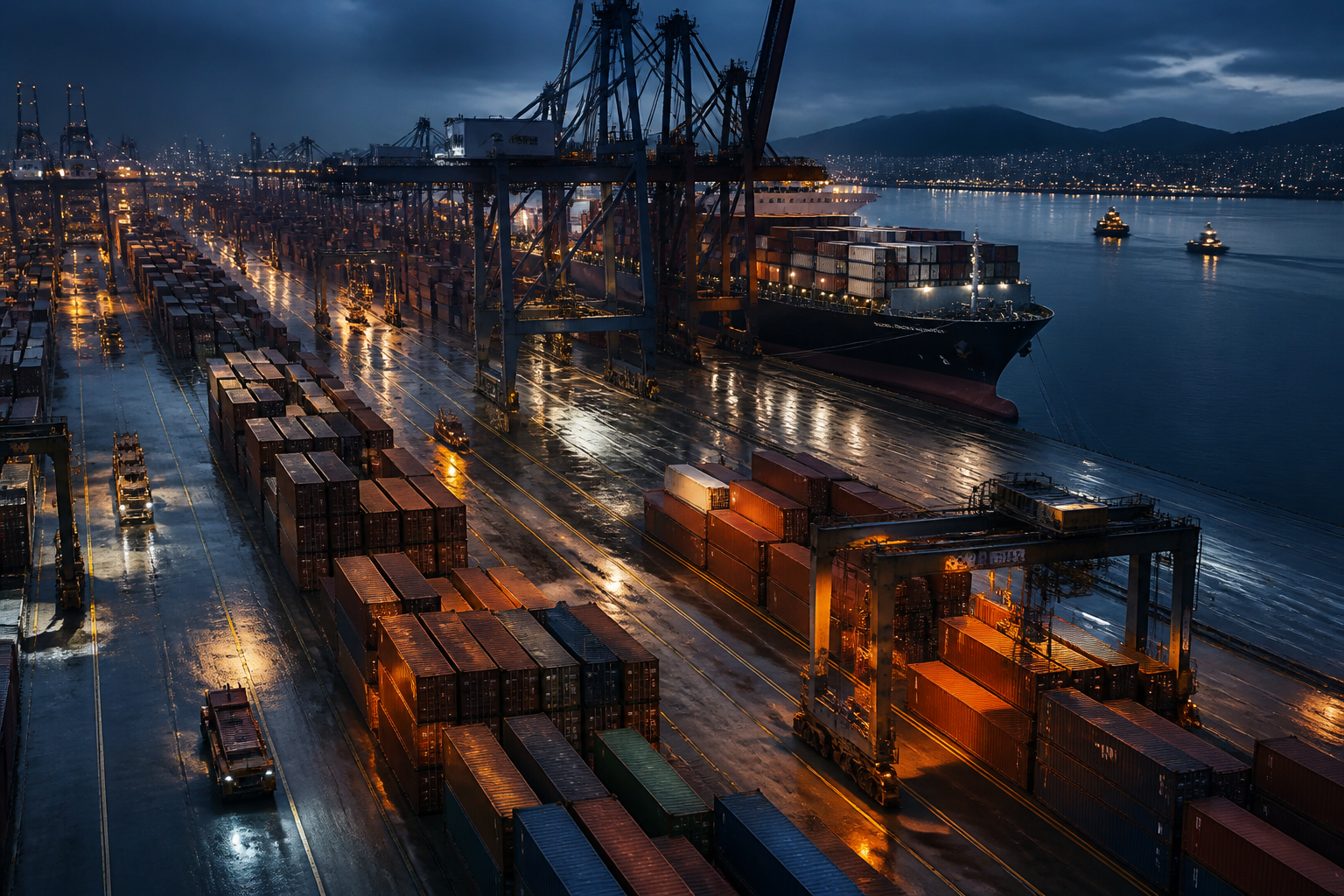
The Logistics Paradox: Navigating The Structural Realignment Of Global Distribution
An in-depth analysis of how multinational firms like Maersk and Amazon are reshaping global trade routes. This editorial explores the shift from cost-optimisation to strategic resilience in a fragmented world.
The prevailing orthodoxy of global trade, which for three decades championed the frictionless movement of goods across borders, is currently undergoing a painful and permanent transformation. This structural shift, often characterised as a retreat from globalisation, is in reality a sophisticated recalibration of how value is moved and stored in an era of heightened geopolitical volatility. The disruption of the Red Sea transit corridors, the persistent drought-related restrictions at the Panama Canal, and the creeping protectionism emanating from both Washington and Brussels have rendered the lean, just-in-time models of the twentieth century obsolete. In their place, a new architecture of commerce is emerging, one where the premium is placed on redundancy, regionalisation, and the total control of the end-to-end distribution stack. As multinational firms grapple with the rising cost of capital and the unpredictability of state-actor interventions, the logistics sector has transitioned from a back-office necessity to the central nervous system of corporate strategy.
The End Of Just-In-Time Orthodoxy
For years, the success of companies like Toyota and Apple was predicated on the absolute minimisation of inventory, a practice that maximised return on equity by ensuring that components arrived only when they were needed. This model functioned perfectly in a world defined by low interest rates, cheap energy, and relative geopolitical calm. However, the successive shocks of the early 2020s exposed the inherent fragility of this lean approach. The contemporary distribution landscape is now defined by just-in-case strategies, where firms are willing to carry significant inventory buffers to guard against sudden supply chain ruptures. This shift has profound implications for warehouse management and capital allocation, as firms must now lock up liquidity in physical stock rather than deploying it in share buybacks or research. The cost of holding this inventory, exacerbated by the highest central bank interest rates seen in a generation, represents a significant drag on margins that must be offset through increased operational efficiencies elsewhere.
The Great Maritime Realignment
Maritime transport, the bedrock of ninety percent of global trade, is facing a crisis of geography. The Suez Canal, which handles roughly twelve percent of global trade, has seen its volumes plummet as shipping giants like A.P. Moller-Maersk and Hapag-Lloyd divert vessels around the Cape of Good Hope to avoid regional conflicts. This diversion adds approximately ten days to a journey from Shanghai to Rotterdam, ballooning fuel costs and straining the availability of empty containers. Simultaneously, the Panama Canal, a critical artery for U.S. grain exports and Asian consumer goods, has been forced to limit vessel transits due to historic water shortages. These geographical bottlenecks are not mere temporary inconveniences, they are signals that the era of effortless global connectivity is ending. Shipping companies are responding by investing in larger, dual-fuel vessels and seeking to integrate vertically by acquiring land-side logistics assets, attempting to offer a seamless service that bypasses the fragmentation of the traditional freight forwarding market.
Nearshoring And The Rise Of Regional Hubs
As the distance between production and consumption becomes a liability, the logic of nearshoring has gained irresistible momentum. Mexico has recently overtaken China as the primary trading partner of the United States, driven by the United States-Mexico-Canada Agreement and the desire for shorter, more resilient lead times. Similarly, in Europe, nations like Poland and Turkey are becoming the preferred manufacturing hubs for the Eurozone, offering a compromise between lower labour costs and geographic proximity. This regionalisation of trade does not mean the end of international commerce, but it does signify a shift toward a hub-and-spoke model where regional ecosystems become more self-sufficient. For distributors, this necessitates a massive investment in local infrastructure, including last-mile delivery networks and regional fulfilment centres that can bypass the risks associated with trans-oceanic shipping. The rise of these regional clusters is also attracting significant foreign direct investment, as firms seek to plant flags in markets where they can ensure continuity of supply despite global instability.
The Digitalisation Of The Physical World
In this environment of high complexity, data has become the ultimate hedge against uncertainty. The distribution sector is witnessing an unprecedented wave of digital investment, as firms seek to achieve total visibility over their supply chains. Artificial intelligence is no longer a buzzword, it is being deployed to predict demand patterns with granular accuracy, allowing retailers like Walmart and Inditex to position stock closer to the consumer before an order is even placed. Digital twins, which are virtual representations of physical supply chains, allow managers to simulate the impact of a port strike or a natural disaster in real time, enabling them to pivot their logistics strategies before the crisis hits the balance sheet. Furthermore, the integration of blockchain technology is beginning to solve the archaic paperwork hurdles that have long plagued cross-border trade, although the path to universal adoption remains hindered by a lack of standardised global regulations. The firms that master these digital tools are gaining a decisive competitive advantage, leaving those who rely on legacy systems vulnerable to the whims of an increasingly erratic global market.
The Labour Crisis And Automation
While technology offers solutions, the human element of distribution remains its most volatile component. Across the United Kingdom and Western Europe, a chronic shortage of heavy goods vehicle drivers and warehouse personnel is driving up wage inflation and forcing a radical rethink of labour relations. The ageing demographic profile of the workforce in developed economies means that these shortages are structural rather than cyclical. In response, the industry is accelerating the adoption of automation. Automated storage and retrieval systems are becoming standard in new fulfilment centres, while the deployment of autonomous trucking is moving from experimental pilots to commercial reality in jurisdictions like Texas. However, the transition to an automated distribution model is not without its social and political frictions. Trade unions are increasingly assertive in demanding protections against displacement, and the capital expenditure required for such systems is immense, favouring large incumbents with deep pockets over smaller, independent distributors who may find themselves priced out of the technological arms race.
The Imperative Of Green Logistics
Sustainability is no longer a peripheral concern for the commerce and distribution sector, it has become a central regulatory and financial mandate. The introduction of the European Union Carbon Border Adjustment Mechanism and stricter emission targets from the International Maritime Organization are forcing firms to account for the environmental cost of every mile travelled. This is driving a move toward the electrification of last-mile delivery fleets and the exploration of alternative fuels for long-haul transport, such as green ammonia and hydrogen. However, the infrastructure for these new fuels is in its infancy, and the cost of transitioning is substantial. Investors are increasingly scrutinising the Environmental, Social, and Governance credentials of logistics firms, with those failing to demonstrate a credible path to net-zero facing higher borrowing costs and potential exclusion from institutional portfolios. The challenge for the industry lies in balancing the immediate need for resilience and speed with the long-term necessity of decarbonisation, a task that requires both immense capital and political willpower.
Future Outlook And Strategic Resilience
Looking toward the end of the decade, the distribution landscape will likely be defined by a stark divergence between the resilient and the vulnerable. We are entering an era of managed trade, where the invisible hand of the market is increasingly guided by the visible hand of the state. Governments will continue to incentivise the domestic production of critical goods, further straining the old models of globalised commerce. For the leaders in the distribution space, the objective is no longer merely to move goods from point A to point B at the lowest possible price. Instead, the goal is to build a distribution network that is sufficiently flexible to adapt to any geopolitical or environmental shock. This will require a hybrid approach that combines the efficiencies of global sourcing with the security of regional buffers. The companies that thrive will be those that view their supply chains not as a series of disparate costs to be minimised, but as a strategic asset to be nurtured. In this new world order, the ability to deliver the right product to the right place at the right time is not just an operational requirement, it is the ultimate expression of corporate power and survival.