The Industrial Triptych: Reshoring, Rates, and the New Global Architecture
A deep analysis of the contemporary industrial landscape, exploring the intersection of restrictive monetary policies, the rise of domestic production hubs, and the impact of geopolitical volatility on global trade.
The global industrial complex is currently undergoing its most profound structural realignment since the advent of the World Trade Organisation. For decades, the primary objective of multinational executive boards was the ruthless pursuit of cost efficiency through hyper-extended supply chains and just-in-one-time logistics. However, recent volatility in the global economic landscape, characterised by the dual pressures of restrictive monetary policy and heightened geopolitical friction, has necessitated a fundamental reappraisal of this doctrine. As central banks, including the Federal Reserve and the Bank of England, navigate the delicate balance between curbing persistent inflation and avoiding a precipitous contraction in output, the industrial landscape must adapt to a higher-cost environment. The era of cheap capital and frictionless trade has effectively concluded, replaced by a more fragmented, security-orientated model that prioritises resilience over sheer margin. This shift is not merely a temporary reaction to recent shocks but represents a permanent shift in the tectonic plates of international commerce.
The Monetary Squeeze and the Resilience of Capital Expenditure
One of the most pressing challenges facing the industrial sector today is the persistence of elevated interest rates. Recent data suggests that the Federal Reserve remains cautious, maintaining a stance that suggests rates may stay higher for longer than equity markets originally anticipated. For capital-intensive industries such as aerospace, automotive, and heavy machinery, this cost of borrowing introduces a significant hurdle for long-term investment. Nevertheless, a curious trend has emerged: despite the increased cost of capital, corporate investment in advanced manufacturing technology has remained remarkably resilient. Large-scale entities are no longer viewing digital transformation and automation as discretionary expenses but as existential imperatives to offset rising labour costs and a dwindling workforce in developed economies. Firms are increasingly turning to sophisticated financial instruments to bridge the gap, yet the underlying reality remains that the hurdle rate for new projects has risen globally.
Technological investment is now the primary lever for productivity growth. In the United Kingdom, Prime Minister Keir Starmer has inherited an economy where industrial strategy must coincide with fiscal discipline, a challenge mirrored across several G7 nations. The industrial sector is being asked to lead the charge in economic growth whilst operating under a regime of tighter credit. This paradox is forcing a consolidation within the middle-market segment, where firms lacking the balance sheet strength to invest in automation are finding themselves at a competitive disadvantage against well-capitalised conglomerates. The result is an industrial landscape dominated by those who can navigate the debt markets with finesse, leveraging public-private partnerships and strategic subsidies to mitigate the impact of restrictive central bank actions.
The Strategic Reorientation of Global Supply Chains
Geopolitical considerations have moved from the periphery of industrial planning to the very centre of the boardroom. The concepts of reshoring and ‘friend-shoring’ are no longer theoretical constructs but are being actively implemented across the Northern Hemisphere. This movement is driven by a recognition that the reliance on concentrated manufacturing hubs in Asia poses a systemic risk to national security and corporate continuity. In response, we are witnessing the emergence of regional clusters, a process of deglobalisation that is more accurately described as a ‘re-regionalisation’. The United States, through various legislative frameworks, has incentivised the repatriation of semiconductor and battery production, a move that has prompted a reciprocal response from the European Union and China. This competition for industrial supremacy is creating a bifurcated trade environment where political alignment is as critical as price competitiveness.
This reorientation is particularly evident in the automotive sector. As the industry pivots towards electrification, the control over the entire value chain, from mineral extraction to final assembly, has become a matter of national industrial policy. European manufacturers are struggling to compete with the vertical integration of Chinese firms, leading to calls for increased tariffs and protective measures. However, such measures are a double-edged sword; while they protect domestic industry, they risk stoking inflation and inviting retaliatory actions that could destabilise global trade further. The delicate task for policymakers is to foster a domestic industrial base without completely alienating the international partners upon whom they still rely for raw materials and technological components. The friction inherent in this process is currently being reflected in market volatility and a cautious outlook from major industrial indices.
Labour Dynamics and the Automation Imperative
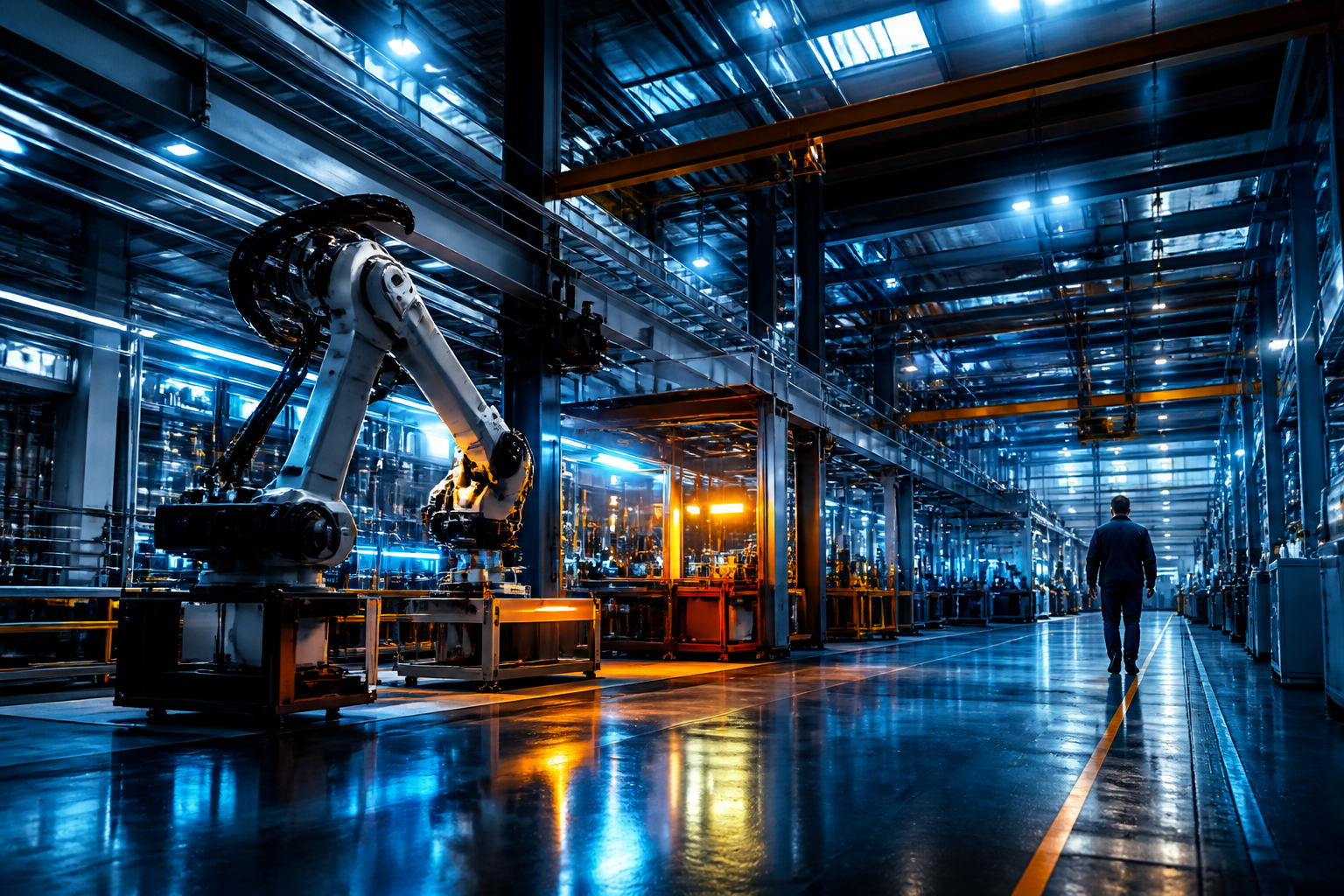
At the heart of the current industrial transformation is a fundamental shift in the labour market. Across the developed world, the manufacturing sector is grappling with a chronic shortage of skilled labour. This is not a transitory phenomenon related to the post-pandemic recovery but a demographic reality. An ageing workforce, combined with a decline in vocational training over previous decades, has created a gap that even higher wages are struggling to fill. Consequently, the industrial sector is at the forefront of the generative AI and robotics revolution. The integration of collaborative robots, or ‘cobots’, onto the factory floor is becoming a standard feature of modern production facilities, allowing manufacturers to maintain output levels with fewer human operators.
This shift towards high-tech manufacturing requires a different kind of worker, one who is proficient in data analysis and system maintenance rather than manual assembly. The social implications of this transition are significant. While it promises higher productivity and, eventually, a boost to GDP growth, it also risks widening the wealth gap between those with technical skills and those without. Institutions such as the World Economic Forum and various national departments of labour are warning that without a concerted effort in ‘upskilling’, the industrial sector could face a social backlash. For the industrialist, the challenge is twofold: securing the talent needed to operate the factory of the future while managing the rising expectations of a workforce that is increasingly aware of its scarcity value.
Energy Transition as an Industrial Catalyst
Perhaps the most influential driver of industrial change in the current decade is the transition to a low-carbon economy. The ‘Green Industrial Revolution’ is not merely a environmental necessity but a colossal economic opportunity, and a significant risk for those who fail to adapt. The decarbonisation of heavy industry, particularly steel and cement production, requires massive investment in hydrogen technology and carbon capture and storage (CCS). Companies like ThyssenKrupp and Holcim are currently leading the way in pilot projects that aim to decouple industrial output from carbon emissions. However, the scale of the required infrastructure spend is unprecedented, demanding a level of coordination between government and industry that has rarely been seen outside of wartime.
Energy security has also become a paramount concern for manufacturers, particularly in Europe following the disruption of traditional gas supplies. This has led to an accelerated adoption of onsite renewable energy generation and battery storage solutions at industrial sites. Manufacturers are increasingly seeking to become ‘prosumers’, both consumers and producers of energy, to hedge against price volatility in the energy markets. This transition is also reshaping the geography of industry; historically, factories were built near coal mines or ports, but the factories of the twenty-first century are increasingly being situated near low-cost renewable energy sources. This shift is creating new industrial heartlands in regions that were previously considered peripheral, while traditional centres face the daunting task of retrofitting legacy infrastructure to meet stringent new environmental standards.
The Digital Twin and the Future of Operations
The digitisation of the industrial process has reached a point of maturity where the ‘digital twin’ has become an indispensable tool for operational efficiency. By creating a real-time virtual simulation of physical assets and processes, companies can predict maintenance needs, optimise energy consumption, and simulate various production scenarios without interrupting actual operations. Companies such as Siemens and Schneider Electric are at the vanguard of this movement, providing the software frameworks that allow for a seamless integration of the physical and digital worlds. This level of granularity in data collection is transforming the supply chain from a linear sequence into an interconnected web of real-time information.
Predictive analytics is also revolutionising the way manufacturers interact with their customers. The shift from selling hardware to providing ‘as-a-service’ models, where customers pay for the uptime of a machine rather than the machine itself, is gaining traction. This model aligns the interests of the manufacturer and the customer, as both benefit from higher reliability and efficiency. However, it also places the burden of risk back onto the manufacturer, necessitating a highly sophisticated approach to risk management and data security. As industrial assets become more connected, they also become more vulnerable to cyber threats, making cybersecurity a Tier-1 strategic priority for every industrial CEO. The convergence of operational technology (OT) and information technology (IT) is the final frontier in the modernisation of the industrial enterprise.
A Forward-Looking Outlook: Navigating the Great Realignment
Looking ahead, the industrial sector enters a period of high-stakes navigation. The transition from the old world of globalised, low-cost manufacturing to a new era of resilient, high-tech, and sustainable production is fraught with complexity. In the short term, the primary concern remains the macroeconomic environment; if the Federal Reserve and the European Central Bank fail to orchestrate a ‘soft landing’, the resulting recession would stifle the very investment needed to complete this transformation. However, the long-term trajectory is clear. The winners of the next decade will be those firms that can successfully integrate advanced technology with sustainable practices while maintaining the agility to respond to a rapidly shifting geopolitical landscape.
We expect to see further consolidation across the industry as the cost of the digital and green transitions proves too high for smaller players to bear alone. Furthermore, the role of government will continue to expand, with industrial policy becoming a core component of national strategy once again. The ‘Laissez-faire’ approach of the late twentieth century is being replaced by a more interventionist framework, as states vie for leadership in the technologies that will define the rest of the century. For the astute investor and the strategic leader, the current volatility is not just a source of risk but a window of opportunity to define their place in the new industrial order. The triptych of reshoring, rates, and the new global architecture is now complete; the task now is to build within its frame.