Industrial Resurgence Amidst the Architecture of Geopolitical Realignment
An analytical exploration of the tectonic shifts in global industry, examining how the interplay between central bank policy, energy transitions, and sovereign trade strategies is reshaping the modern manufacturing landscape.
The global industrial complex is currently navigating a period of profound structural adjustment, characterized by the intersection of aggressive monetary tightening and a fundamental reassessment of cross-border supply dependencies. As the Federal Reserve moves to manage market volatility and interest rate expectations, and the United Kingdom’s administration under Sir Keir Starmer attempts to foster a period of domestic economic stability, the corporate world is grappling with a paradox of rising costs and necessary capital investment. This editorial examines the precarious balance between maintaining the efficiency of globalised production and the increasing imperative for localized security in key sectors. The following analysis suggests that the era of unencumbered trade is yielding to a more segmented, strategically managed industrial environment where resilience is preferred over simple cost minimization.
The Monetary Tightening and Capital Expenditure Equilibrium
Recent data from the Federal Reserve and the European Central Bank suggest that the prolonged era of cheap capital has definitively concluded. This shift has significant implications for capital-intensive industries ranging from heavy manufacturing to semiconductor fabrication. For firms such as Intel or Siemens, the rising cost of borrowing necessitates a more disciplined approach to infrastructure expansion. While inflationary pressures on raw materials have begun to show signs of moderation, the ‘sticky’ nature of labour costs and energy inputs continues to weigh heavily on profit margins. The Deloitte Economic Outlook underscores that while global recessionary fears have partially receded, the high-interest-rate environment remains a persistent hurdle for medium-term industrial planning. Consequently, many multinational corporations are reviewing their balance sheets, prioritising the reduction of debt over speculative capacity increases.
This fiscal conservatism is occurring at a time when technological investment is most required. The integration of artificial intelligence and automated systems within the factory floor is no longer a luxury but a prerequisite for competitiveness. However, the financing of such transformations under current lending conditions presents a formidable challenge. In the United Kingdom, the nascent Starmer government faces the daunting task of incentivising private investment within a landscape of fiscal constraint. Market participants are closely monitoring the Labour administration's approach to industrial strategy, seeking assurances that the transition toward a greener, digital-first economy will be supported by a stable regulatory and tax environment. The broader European context remains equally complex, as the bloc attempts to reconcile its environmental mandates with the need to protect its traditional automotive and chemical industries from cheaper international competition.
The Reconfiguration of Global Supply Networks
Historically, industrial efficiency was predicated on the pursuit of the lowest possible unit cost, a philosophy that birthed the complex, extended supply chains of the late twentieth century. However, the disruptions of recent years, ranging from geopolitical conflicts to public health crises, have exposed the inherent vulnerabilities of this model. We are now witnessing a systemic transition toward ‘friend-shoring’ and ‘near-shoring,’ as companies seek to insulate themselves from geopolitical shocks. This is notably evident in the United States, where the Biden administration's CHIPS and Science Act has spurred a wave of domestic manufacturing investment. The goal is not merely economic growth but national security, ensuring that critical components such as advanced microprocessors and high-capacity batteries are produced within accessible jurisdictions.
This realignment is not without its costs. The efficiency gains of global specialization are being sacrificed for the sake of redundancy and reliability. Mexico and Vietnam have emerged as significant beneficiaries of this trend, as companies diversify their manufacturing footprints away from traditionally dominant hubs. Nevertheless, the logistical infrastructure in these emerging hubs often lacks the maturity of established markets, leading to a new set of operational challenges. For logistics giants like Maersk and FedEx, this shift requires a complete redesign of shipping routes and distribution networks. The industrial sector must therefore navigate a fragmented landscape where the geography of production is increasingly dictated by diplomatic alliances rather than purely economic logic.
Energy Transition and the Industrial Pivot
No factor is more central to the future of the industrial desk than the global energy transition. The decarbonization of heavy industry, steel, cement, and petrochemicals, is perhaps the most significant engineering challenge of the twenty-first century. Institutions such as the International Energy Agency have highlighted the staggering scale of investment required to reach net-zero targets. For established players like Shell or BP, the transition involves a delicate balancing act between maintaining legacy assets and pivoting toward renewable energy solutions. The volatility in global oil and gas prices, exacerbated by regional conflicts, has reinforced the necessity of energy independence, further accelerating the adoption of wind, solar, and nuclear power within industrial peripheries.
However, the transition is fraught with technical and financial risks. The development of green hydrogen, for instance, remains in its infancy, requiring substantial subsidies and a massive expansion of renewable capacity to become commercially viable. In Germany, the industrial heartland of Europe, the sudden loss of cheap natural gas has forced a rapid and painful adaptation. Manufacturers are being compelled to innovate at a speed that threatens their immediate competitiveness. The success of this pivot will depend on the ability of governments to create a ‘green’ industrial policy that supports early movers without distorting the market to the point of inefficiency. The emergence of carbon border adjustment mechanisms is one such attempt to level the playing field, ensuring that domestic industries are not disadvantaged by lower environmental standards elsewhere.
Technological Integration and the Labour Paradigm
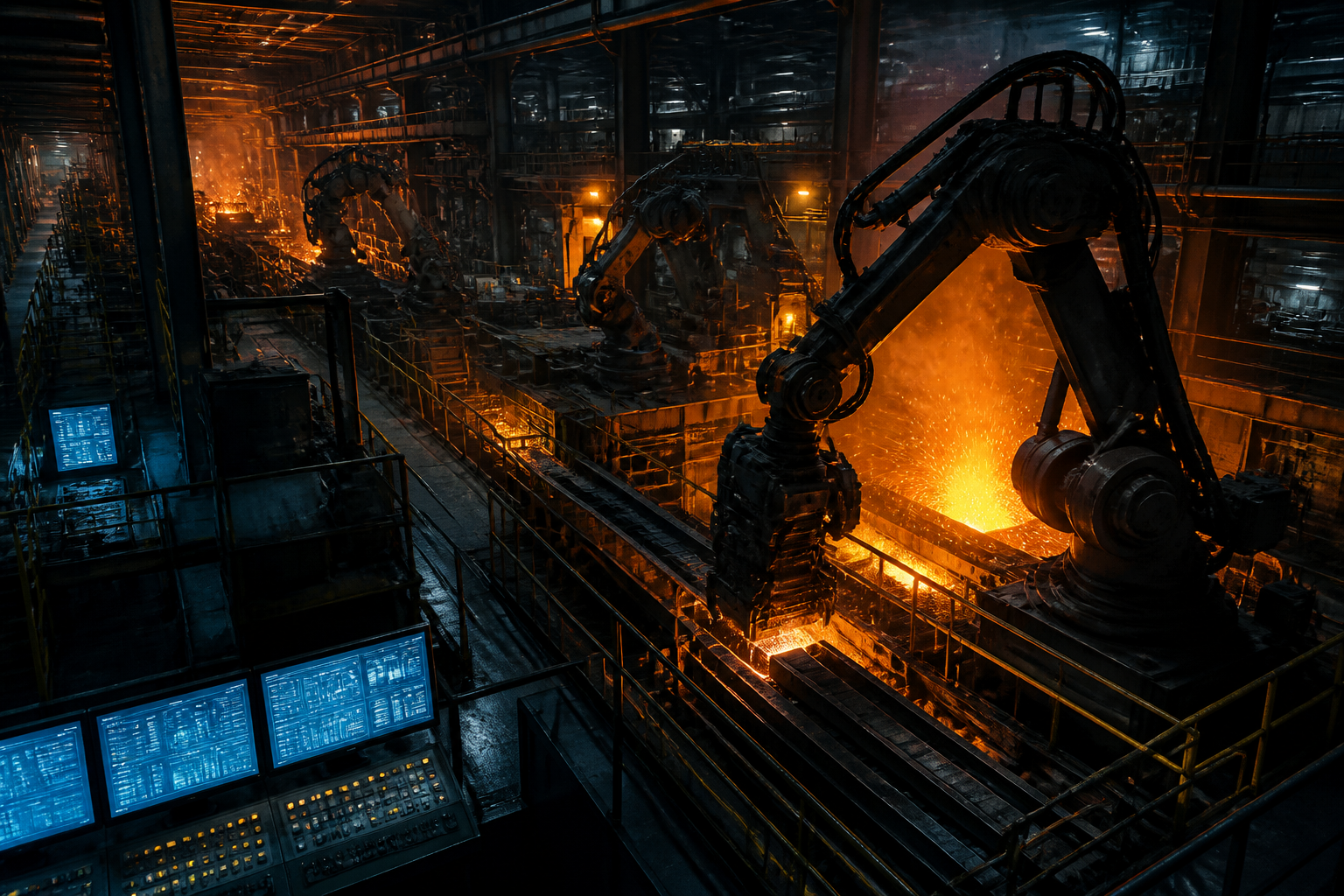
The industrial sector is currently at the vanguard of the Fourth Industrial Revolution, where the physical and digital worlds converge. The deployment of generative AI and machine learning in predictive maintenance and supply chain optimization is already delivering marginal gains that, in aggregate, are transformative. Companies like General Electric and Rolls-Royce are increasingly pivoting toward a ‘servitization’ model, where data-driven insights are sold alongside physical hardware. This transition requires a workforce with a markedly different skill set than that of previous generations. The labour market, however, is struggling to keep pace. Reports from various economic calendars indicate a persistent shortage of skilled technicians and engineers, which is driving up wage inflation and limiting the speed of technological adoption.
This skills gap is exacerbated by demographic shifts in advanced economies. An ageing workforce means that a significant portion of industrial knowledge is reaching retirement age, often without a sufficient pipeline of new talent to replace it. Addressing this requires a concerted effort from both the private sector and educational institutions. Vocational training and lifelong learning must become central pillars of any national industrial strategy. Furthermore, the psychological shift required for workers to collaborate with increasingly autonomous systems cannot be understated. The future factory will not be an environment of repetitive manual labour but a hub of complex problem-solving and systems management. Those firms that can successfully navigate this human-machine synthesis will possess a significant competitive advantage.
Trade Policy and the New Protectionism
The return of industrial policy to the forefront of governance has coincided with a resurgence of protectionist sentiment. Tariffs and trade barriers, once viewed as relics of a pre-globalised era, have returned as primary tools of statecraft. The ongoing tension between Washington and Beijing continues to cast a long shadow over global markets, with implications for everything from rare earth mineral supply chains to electric vehicle exports. For the global industrialist, this means that political risk must now be factored into every strategic decision. The era of ‘hyper-globalization’ has ended, replaced by a more contentious and transactional international order.
This new protectionism is often framed as a defense of local industry and jobs, but its long-term effects on global productivity are concerning. By fragmenting markets, these policies risk stifling innovation and increasing costs for consumers. The World Trade Organization (WTO) has warned that a bifurcated global economy could lead to a permanent reduction in global GDP. For diversified conglomerates, the challenge is to maintain operational cohesion across different regulatory regimes. The need for a robust corporate diplomacy function has never been greater, as firms find themselves caught in the crossfire of sovereign disputes. Success in this environment requires a high degree of agility and a nuanced understanding of the political landscape in every market of operation.
Industrial Outlook: Resilience as the Primary Currency
Looking ahead, the trajectory of the industrial sector will be defined by its ability to synthesize technological advancement with geopolitical awareness. The immediate future is likely to be characterized by continued volatility as markets adjust to the reality of higher interest rates and ongoing energy instability. However, this period of disruption also offers an opportunity for a ‘great reset’ of industrial practices. Those companies that prioritize resilience, through diversified supply chains, sustainable energy practices, and a commitment to workforce development, will be the ones that thrive in the coming decade.
We anticipate a consolidation of industrial power among firms that can master the complexities of the green transition. The ‘green premium’ will eventually diminish as technologies mature, but the early adopters will have already established dominant positions in the new energy economy. Furthermore, the regionalization of trade will continue to accelerate, leading to the development of powerful regional industrial clusters. While the total volume of global trade may stabilize or even decline in certain sectors, the value of that trade will increasingly reside in high-tech, high-precision manufacturing. The industrial sector is not in decline; rather, it is undergoing a profound metamorphosis, emerging as a sleeker, smarter, and more strategically aligned engine of global growth. The successful industrial leader of tomorrow will be a polymath, equally adept at navigating a balance sheet, a boardroom, and the complexities of international diplomacy.