The Industrial Reconfiguration: Navigating Post-Globalisation And Monetary Divergence
An analytical deep dive into the shifting paradigms of global industry, examining how fluctuating inflation data, regional free-market reforms, and divergent monetary policies are reshaping the international trade order.
The global industrial complex currently finds itself at a critical inflection point, caught between the waning momentum of the post-pandemic recovery and the nascent frictions of a fragmented geopolitical order. For decades, the primary directive of international manufacturing was the pursuit of cost efficiency and the harmonisation of global supply chains. However, as contemporary data from major financial hubs suggests, this era of predictable integration has been superseded by a more volatile reality. Centred on the delicate interplay between inflationary pressures and the policy responses of institutions such as the Federal Reserve and the European Central Bank, the industrial roadmap for the remainder of the decade is being redrawn. Observations from Deloitte Insights indicate that while the global economy has displayed a degree of resilience, the underlying fractures in productivity and the high cost of capital are beginning to weigh heavily on heavy industry and capital-intensive sectors. This transition is not merely cyclical but structural, as firms move from 'just-in-time' logistics to 'just-in-case' resilience, a shift that carries significant implications for profit margins and long-term capital expenditure.
The Paradox of Monetary Divergence
The prevailing narrative within the financial corridors of London, New York, and Frankfurt has shifted from a unified struggle against inflation to a nuanced debate over the timing of monetary easing. While the US Federal Reserve maintains a cautious stance, awaiting definitive evidence that inflation is sustainably returning to its two-per-cent target, other jurisdictions are beginning to break rank. This divergence in monetary policy represents a significant risk for multinational industrial corporations. A stronger dollar, sustained by higher-for-longer interest rates in the United States, places immense pressure on emerging markets that rely on dollar-denominated debt to fund industrial expansion. Conversely, as noted by recent updates from Yahoo Finance and Kiplinger, the market remains hyper-fixated on specific data releases, most notably the Personal Consumption Expenditures (PCE) price index, as a barometer for the next phase of global credit conditions.
For industrial conglomerates such as Siemens or General Electric, this monetary volatility complicates long-cycle project financing. When the cost of borrowing remains high, the hurdle rate for new investments in automation and decarbonisation rises accordingly. We are witnessing a strategic pause in large-scale infrastructure commitments as boards await a clearer signal from central bankers. The industrial sector is particularly sensitive to these rates because of its high fixed costs and lengthy depreciation schedules. Without a synchronised reduction in global interest rates, the industrial landscape risks becoming bifurcated: one Tier-1 group of firms with the balance sheet strength to internalise costs, and a second tier of smaller manufacturers struggling to survive under the burden of expensive debt servicing.
Geopolitical Risk and the New Protectionism
Beyond the immediate concerns of the treasury department, the industrial sector is grappling with a profound reordering of the international trade system. The era of unfettered free trade is being replaced by a more muscular form of industrial policy, often termed 'new protectionism'. From the Inflation Reduction Act in the United States to the European Green Deal, governments are increasingly using fiscal incentives to repatriate critical manufacturing capabilities, particularly in the semiconductor and renewable energy sectors. This shift is not without its costs. While it provides a safety net for domestic firms, it risks stoking trade tensions with traditional partners and rivals alike. The recent intensification of trade scrutiny between the EU and China over electric vehicle subsidies serves as a primary example of how industrial policy is now a frontline tool of foreign diplomacy.
These geopolitical shifts are also forcing a rethink of traditional emerging market roles. As documented by CNN Business and US News, even historically closed or centrally planned economies are feeling the pressure to reform. Cuba’s recent moves toward sweeping free-market reforms, the most significant since its revolution, signal a wider recognition that the old models of industrial state control are insufficient in a high-tech, globalised economy. Similarly, the growing influence of Middle Eastern powers, specifically a more confident Iran and the diversified sovereign wealth funds of the Gulf states, is altering the flow of industrial capital. Regions that were once solely providers of raw materials are now aggressively moving up the value chain, demanding technology transfers and domestic manufacturing components as the price for access to their markets and energy resources.
The Efficiency Drive: Automation and Labour Dynamics
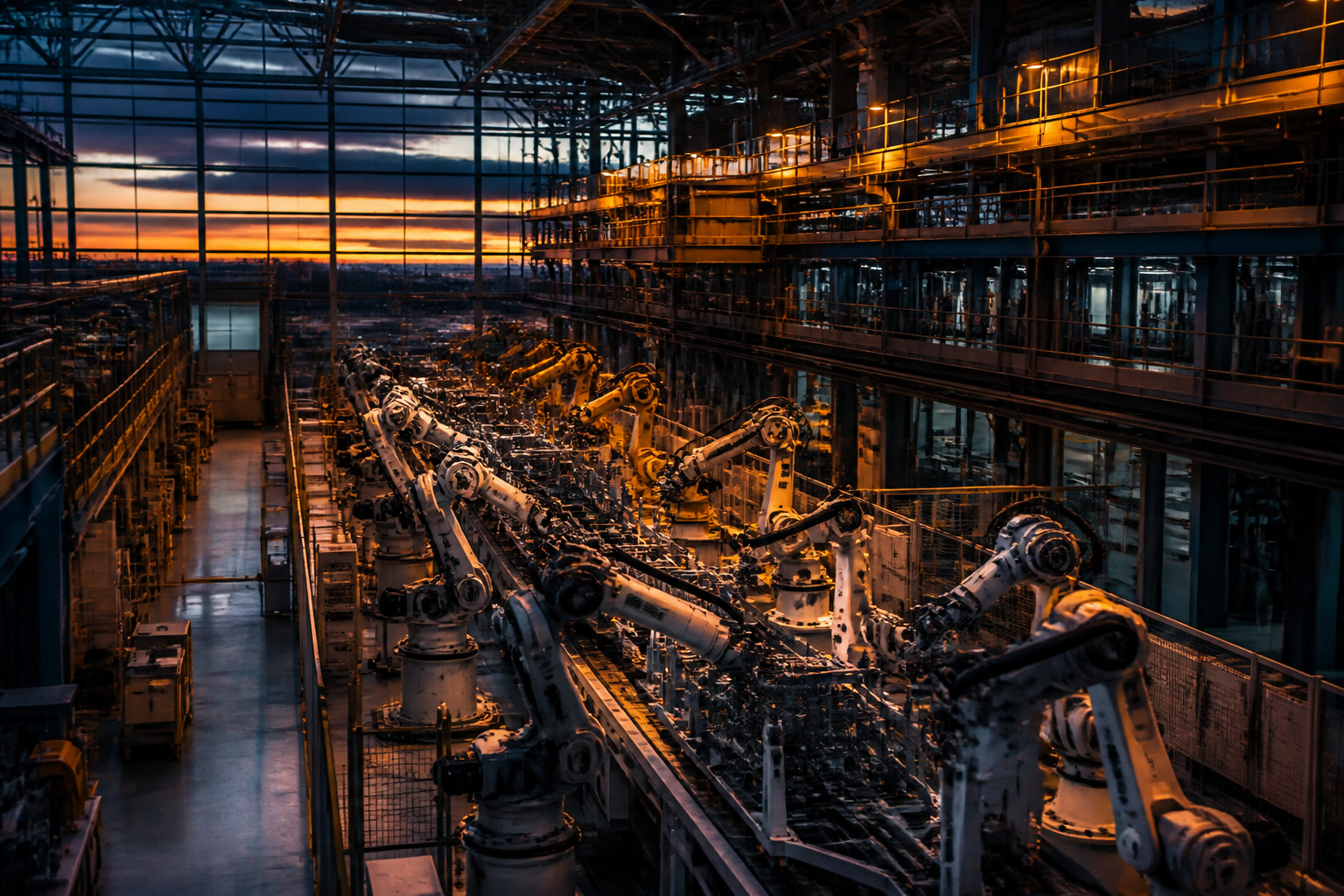
Faced with rising input costs and a tightening labour market in the developed world, the industrial sector is doubling down on the integration of advanced technologies. The conversation has moved beyond basic robotics to the implementation of 'digital twins' and generative AI in factory floor management. Industrial leaders are no longer just competing on the quality of their physical output but on the sophistication of their data ecosystems. This digital transformation is an existential necessity; as Deloitte's economists observe, the countries that are successfully navigating the current economic slowdown are those that have prioritised productivity gains through technological adoption over mere scale.
However, this rapid automation brings a complex set of socio-economic challenges. The industrial workforce is undergoing its most significant transition since the introduction of the assembly line. There is a growing skills gap that threatens to stall the progress of the high-tech manufacturing sector. Educational institutions and corporate training programmes are struggling to keep pace with the demand for workers who can manage complex automated systems. In the United Kingdom and Germany, two traditional heartlands of engineering excellence, the shortage of technical labour is frequently cited as a primary bottleneck for industrial growth. For the sector to remain competitive, a new social contract regarding worker retraining and the distribution of productivity gains will likely be required.
Energy Transition as an Industrial Catalyst
The necessity of the green transition acts as perhaps the most potent driver of industrial change in the twenty-first century. No longer seen purely through the lens of environmental compliance, the decarbonisation of industry is now a race for technological supremacy. Companies that can pioneer low-carbon steel production, hydrogen-based fuels, and long-duration battery storage will be the architects of the next industrial era. This requires a massive reallocation of capital. The International Energy Agency has repeatedly highlighted the scale of investment needed to reach net-zero targets, and the industrial sector sits at the heart of this challenge.
This transition is creating new winners and losers across the globe. Scandinavia, with its abundant renewable energy, is becoming a hub for green data centres and battery manufacturing. Meanwhile, regions that have historically relied on heavy, carbon-intensive industries are facing a painful period of deindustrialisation unless they can successfully pivot. The challenge for policymakers is to ensure that the transition is 'just', preventing the creation of new rust belts. This involves not only funding green research and development but also providing the infrastructure, such as smart grids and carbon capture networks, that will allow legacy industries to evolve. The industrial giants of tomorrow will be those that view sustainability as a core component of their operational architecture rather than a peripheral marketing concern.
Supply Chain Resilience and the Rise of Nearshoring
The fragility of global supply chains, cruelly exposed during the early 2020s, has led to a fundamental reassessment of 'offshoring'. The new industrial orthodoxy is 'nearshoring' or 'friend-shoring', locating production closer to the end-market or in politically aligned nations. This is significantly benefiting countries such as Mexico, which is seeing a surge in manufacturing investment as US-based firms look to shorten their supply lines. In Europe, we see similar trends with a renewed focus on Eastern European manufacturing hubs that offer a balance of lower costs and proximity to the single market.
This re-regionalisation of industry is likely to lead to a more resilient, though potentially more expensive, global economy. Reducing vertical integration in favour of regional clusters allows for greater flexibility in responding to local demand shocks. However, it also fragments the global market, potentially leading to a loss of the economies of scale that helped keep consumer prices low for decades. For the industrial analyst, the key metric to watch is the 'total cost of ownership', which now includes a significant premium for security of supply and political stability. The valuation of industrial firms will increasingly reflect their ability to navigate this fragmented landscape without sacrificing operational efficiency.
A Forecast for the Industrial Horizon
Looking ahead, the global industrial sector must prepare for a prolonged period of volatility. The 'Great Moderation' of low inflation and steady growth is firmly in the rearview mirror. In its place is a more contested and complex environment where economic success is inextricably linked to geopolitical savvy and technological agility. The divergence in central bank policies will likely continue through the fiscal year, necessitating sophisticated hedging strategies and a disciplined approach to capital allocation. Firms that have over-leveraged during the era of 'free money' will face a reckoning as they attempt to refinance in a higher-rate environment.
Ultimately, the resilience of the industrial sector will be tested by its ability to innovate under pressure. We expect to see an acceleration in merger and acquisition activity as larger players seek to acquire the niche technological capabilities required for the green and digital transitions. At the same time, the importance of the 'S' and 'G' in ESG (Environmental, Social, and Governance) will grow, as the industrial sector remains under intense scrutiny from both regulators and the public regarding its role in the wider community. The path forward is one of disciplined transformation; for the perceptive investor and the strategic leader, the current period of disruption offers a unique opportunity to secure a position in the new industrial vanguard. The firms that emerge successful will be those that view these headwinds not as obstacles, but as the friction necessary to gain traction in a rapidly evolving global market.