Industrial Realignment: The High Stakes of Decoupling and Technological Sovereignty
An in-depth analysis of the current industrial landscape, exploring how semiconductor volatility, credit downgrades in the automotive sector, and the rise of sovereign cloud infrastructure are reshaping global trade.
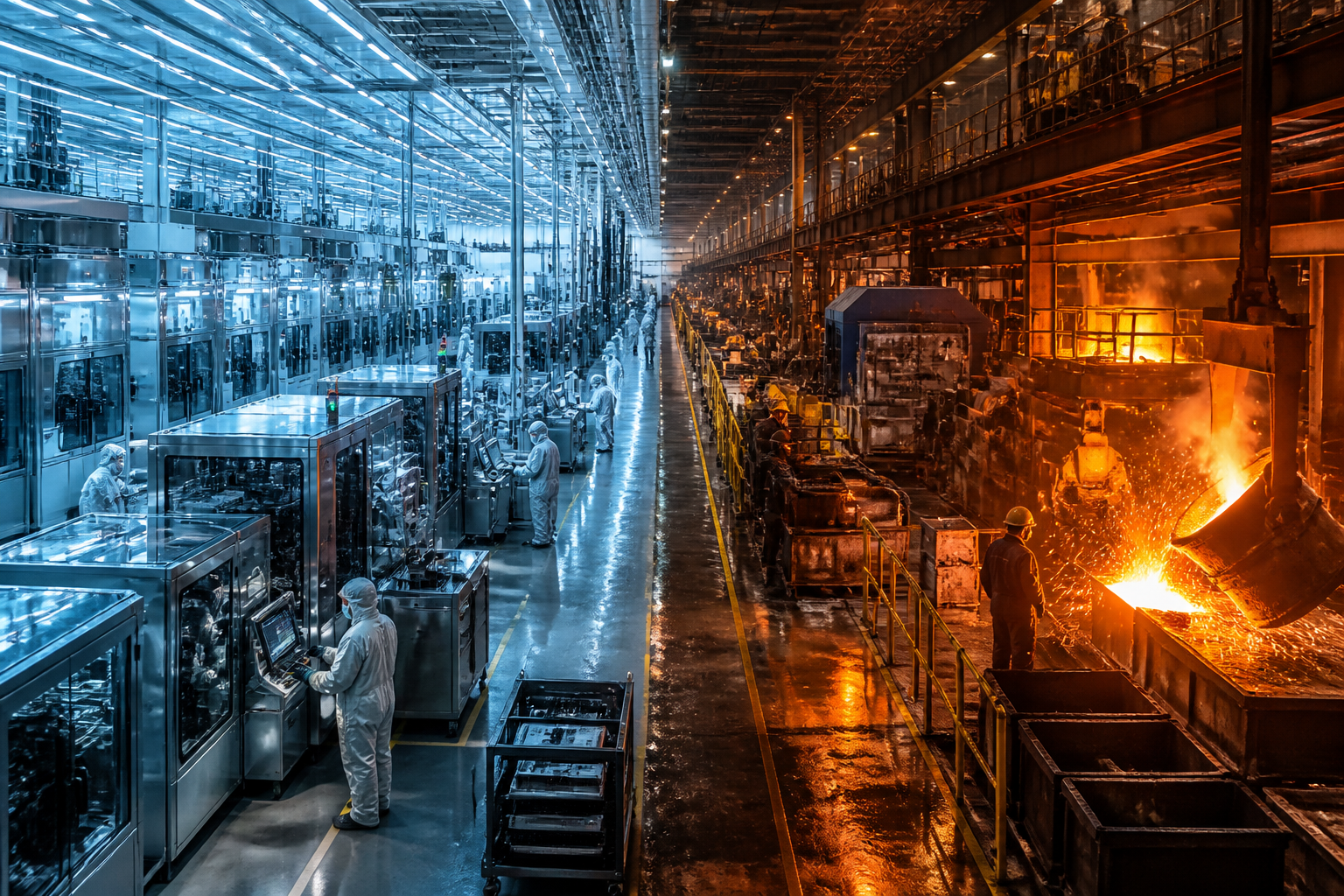
The contemporary global industrial complex finds itself at an historical inflection point, caught between the inertia of late-stage globalisation and the urgent pressures of a decentralised, technologically fractured future. Recent market movements, characterised by significant volatility across the semiconductor sector and a deepening divergence in credit stability between legacy manufacturers and emerging tech giants, suggest that the era of predictable supply chains has been definitively superseded by a regime of strategic resilience. As the S&P Global Ratings downward revision of Harley-Davidson into speculative territory illustrates, the struggle to balance brand prestige with the economic necessity of lower-cost diversification is becoming a recurring theme across the manufacturing landscape. Meanwhile, the aggressive pivot by entities such as Meta into cloud infrastructure underscores a broader movement where software conglomerates are increasingly assuming the roles traditionally held by industrial utilities. This realignment is not merely a cyclical adjustment but a fundamental structural shift that demands a total reappraisal of how sovereign states and private capital interact within the global marketplace.
The Semiconductor Paradox and National Security
The reliance of modern industry upon advanced silicon remains the most critical vulnerability within the global economy. While chipmakers have historically served as the primary engine for equity market appreciation, the current climate is defined by an increasingly complex relationship between volume and geopolitical security. The recent buoyancy in tech stocks, driven by renewed investments in artificial intelligence and high-performance computing, masks an underlying anxiety regarding the geographic concentration of fabrication facilities. The industrial logic that favoured cost-efficiency in East Asian hubs is now being challenged by the strategic imperative of onshore production. Governments across Europe and North America are attempting to recalibrate their domestic capabilities, yet the capital expenditure required to achieve parity with established leaders remains a daunting fiscal challenge. This paradox, where the demand for processing power is infinite but the physical infrastructure remains perilously concentrated, represents the primary risk to industrial continuity in the middle of the decade.
Credit Contagion and the Legacy Manufacturing Dilemma
Transitioning from high-end, niche dominance to mass-market appeal has often proved a treacherous path for established industrial icons. The recent downgrade of Harley-Davidson by S&P Global Ratings serves as a cautionary tale for the broader automotive and manufacturing sectors. By attempting to capture a broader consumer base through lower-cost products, the company has inadvertently pressured its margins and diluted the brand equity that previously protected its credit position. This phenomenon is indicative of a wider malaise among legacy manufacturers who are struggling to adapt to a high-interest-rate environment and shifting consumer preferences. The fragility of the yen and the subsequent interventions by Japanese financial authorities further complicate the picture for international exporters, who must navigate currency volatility that can erase profit margins overnight. The divergence between companies that can maintain premium pricing and those forced into price wars is creating a two-tier industrial hierarchy, where creditworthiness is increasingly tied to technological agility rather than historical pedigree.
The Emergence of Sovereign Cloud and Data Infrastructure
As traditional heavy industry grapples with credit constraints, the digital infrastructure sector is expanding its remit to encompass what were once considered public or industrial utilities. Meta’s exploration of private cloud business models represents a significant expansion of the traditional tech mandate. By moving beyond social media and advertising into core infrastructure, these firms are positioning themselves as the essential backbone of the modern economy. This shift has profound implications for industrial sovereignty, as the control of data and processing becomes as vital as the control of steel or energy. The move toward 'sovereign clouds', infrastructure that resides within specific legal jurisdictions, reflects a growing awareness that data is the primary commodity of the fourth industrial revolution. This development forces a confrontation between the borderless nature of the internet and the rigid requirements of national security, creating a new landscape where industrial policy is increasingly indistinguishable from digital regulation.
Monetary Policy and the Industrial Cost of Capital
The broader economic context remains dominated by the actions of central banks, whose efforts to tame inflation have fundamentally altered the cost of industrial expansion. The Bank of Japan’s cautious stance on policy communication highlights the delicate balancing act required to manage currency stability without stifling nascent growth. For industrial firms, the end of the zero-interest-rate era means that the era of 'cheap money', which funded much of the automation and digitisation seen over the last decade, has concluded. Future projects must now clear higher hurdles for return on investment, leading to a more disciplined, if slower, pace of industrial modernisation. This environment favours incumbents with deep cash reserves while penalising smaller innovators and highly leveraged legacy firms. The resulting consolidation of industrial power into a few highly capitalised players could limit competition and slow the overall pace of sectoral innovation in the long term.
Supply Chain Resilience in an Era of Interventionism
The shift from 'just-in-time' to 'just-in-case' logic is no longer a temporary reaction to pandemic-era disruptions but a permanent fixture of corporate strategy. Industrial leaders are increasingly prioritising the redundancy of supply chains over the efficiency of global logistics. This protectionist impulse is being reinforced by government interventions, such as the potential for currency market actions and trade barriers designed to protect domestic manufacturers. The risk of such interventionism is a fragmentation of global trade that increases costs for consumers and reduces the overall efficiency of the global industrial machine. However, many planners argue that this is a necessary price to pay for security. The rise of regional trading blocs and the re-shoring of critical components suggest that the globalised model of the late twentieth century is being dismantled in favour of a more balkanised system, where geopolitical alignment is as important as price and quality.
A Forecast for the Post-Globalised Industry
Looking ahead, the next three to five years will likely see a widening gap between those industrial entities that have successfully digitised their operations and those still tethered to traditional manufacturing models. The integration of artificial intelligence into the factory floor and the supply chain is no longer a luxury but a requirement for survival. We anticipate a period of significant merger and acquisition activity, as cash-rich technology firms acquire distressed legacy manufacturers to gain access to physical assets and established distribution networks. Furthermore, the role of the state in industrial development will continue to expand, with subsidies and strategic trade policies becoming the primary drivers of growth. While this may lead to inefficiencies, it will also foster a new generation of national champions capable of competing in a more contested and volatile global arena. The ultimate winners in this new era will be those who can navigate the complexities of a multi-polar world while maintaining the technological edge required to define the next phase of human productivity.