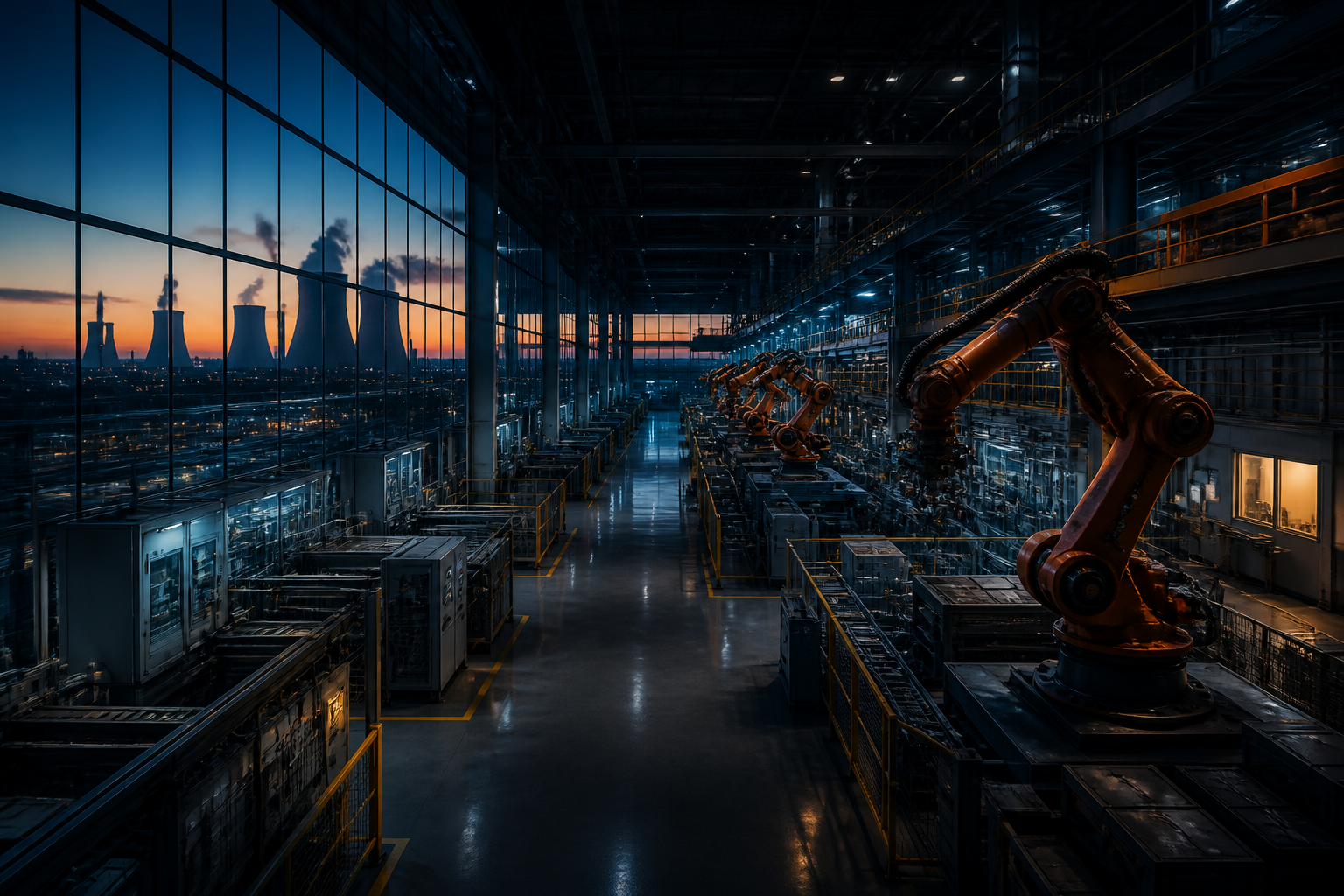
Industrial Inertia and the Capital Conundrum: The Crisis of European Manufacturing
An analytical exploration of the systemic challenges facing European industry. As high energy costs and regulatory burdens weigh on the DAX and CAC 40, we assess the urgent need for radical structural reform.
The prevailing silence in the boardroom corridors of Frankfurt and Paris belies a profound systemic instability that now threatens the very foundations of the European social model. For decades, the Continent’s economic hegemony was predicated upon a symbiotic trifecta of affordable Russian hydrocarbons, burgeoning Chinese consumer demand, and a dependable American security umbrella. In the wake of the geopolitical ruptures of the early 2020s, each of these pillars has not merely crumbled but has been replaced by active liabilities. As the European Central Bank maintains a hawkish vigil over stubborn core inflation, the private sector finds itself caught in a pincer movement between prohibitive capital costs and a structural energy price disadvantage that renders traditional industrial processes increasingly unviable. This is no longer a cyclical downturn capable of being managed through temporary subsidies; it is a fundamental realignment of the global value chain where Europe, once the world’s workshop, risks becoming a mere boutique museum of industrial heritage.
The German Engine in Reverse
The most acute manifestation of this malaise is found in the Federal Republic of Germany, the historical engine of European prosperity. For the first time since the post-war reconstruction, the concept of Deindustrialisierung is no longer a theoretical spectre but a documented reality. BASF, the world’s largest chemical producer, has been forced to downsize its historical Ludwigshafen site, redirecting billions in investment toward the Zhanjiang Verbund site in China. The logic is as cold as it is compelling: when the cost of natural gas in the European internal market remains three to four times higher than the Henry Hub benchmark in the United States, energy-intensive manufacturing becomes an exercise in capital destruction. This haemorrhaging of industrial capacity is not limited to chemicals. The automotive sector, long the pride of the German Mittelstand, faces an existential challenge from both the vertically integrated efficiency of Tesla and the aggressive state-backed expansion of Chinese marques like BYD and NIO. The transition to electromobility has exposed a critical vulnerability in European engineering: the mastery of the internal combustion engine is a legacy skill in a world governed by software-defined vehicles and battery chemistry.
The Divergent Transatlantic Productivity Gap
While Europe grapples with its energy dependencies, the widening productivity gulf between the Eurozone and the United States has reached a critical inflection point. Since the 2008 financial crisis, the American economy has demonstrated a remarkable capacity for creative destruction and technological renewal, fueled by a deep and liquid venture capital ecosystem. In contrast, European capital remains trapped in a fragmented banking union and a risk-averse regulatory framework that prioritises the precautionary principle over disruptive innovation. The implementation of the Inflation Reduction Act (IRA) in the United States has further exacerbated this imbalance, acting as a powerful magnet for green technology investment that might otherwise have stayed in the Rhine Valley. European firms are now faced with a stark choice: maintain their domestic manufacturing base and face eroding margins, or relocate production to North America to take advantage of subsidised capital and lower operating costs. The result is a quiet but steady exodus of intellectual property and high-value jobs that will be difficult to recover.
Regulatory Chokeholds and the Burden of Compliance
Brussels has long viewed its regulatory prowess, the so-called ‘Brussels Effect’, as a form of soft power that allows the European Union to set global standards for privacy, environmental protection, and competition. However, the cumulative weight of the General Data Protection Regulation (GDPR), the Carbon Border Adjustment Mechanism (CBAM), and the burgeoning AI Act is creating an environment where compliance costs are stifling the very enterprises they seek to protect. For a mid-sized French manufacturer or an Italian precision engineering firm, the administrative burden of reporting on complex global supply chains is becoming a significant barrier to international competitiveness. While the intent of these regulations is noble, the creation of a sustainable and ethical market, the timing is precarious. In an era of rampant geopolitical mercantilism, Europe is attempting to play by the rules of a multilateral order that its primary competitors in Washington and Beijing have effectively abandoned. This regulatory idealism may well lead to a high-standard economy that simply lacks the industrial scale to influence the global stage.
Financing the Transition in a High-Rate Environment
The end of the era of ‘lower for longer’ interest rates has stripped away the veil of liquidity that previously obscured structural inefficiencies in the European corporate sector. As the European Central Bank grappled with the inflationary shocks of 2022 and 2023, the cost of debt service for highly leveraged industrial groups spiked, leading to a mandatory retrenchment in capital expenditure. Unlike their American counterparts, European firms rely heavily on bank lending rather than public equity markets for growth capital. This dependency makes the continental economy particularly sensitive to the tightening cycles of the Frankfurt-based central bank. Furthermore, the lack of a completed Capital Markets Union prevents the efficient flow of cross-border investment, leaving promising European scale-ups to seek NASDAQ listings if they wish to achieve global reach. Without a fundamental deepening of domestic capital markets, Europe will continue to generate world-class research at institutions like Max Planck or Oxford, only to see the commercial fruits harvested by Silicon Valley venture funds.
The Geopolitical Fragility of the Supply Chain
The reliance on the Chinese market, which once provided a lucrative outlet for luxury goods and high-end machinery, has transformed from a strategic asset into a profound vulnerability. As Beijing pivots toward an internal model of ‘dual circulation’ and increases its own manufacturing self-sufficiency, European household names, from LVMH to Volkswagen, find themselves navigating a treacherous landscape of slowing growth and rising nationalism. The prospect of a decoupling, or even a ‘de-risking,’ presents an immense logistical challenge. Re-shoring production to the European periphery, such as Poland or Romania, offers some respite in terms of labour costs, but it does not solve the fundamental issues of energy pricing and infrastructure bottlenecks. Moreover, the increasing weaponisation of trade through export controls on critical minerals and semiconductors places European manufacturers in the crossfire of the Sino-American rivalry. The Continent’s lack of a unified foreign policy on trade leaves individual member states vulnerable to bilateral pressure, undermining the collective bargaining power of the Single Market.
A Strategic Outlook for the Coming Decade
The path forward for European industry requires more than incremental adjustments; it demands a radical reimagining of the Continent’s economic base. To survive, the European manufacturing sector must lean into the one area where it still maintains a comparative advantage: high-complexity, high-value engineering that integrates deep-tech solutions with traditional craftsmanship. This necessitates a massive reallocation of capital toward digitisation and the rapid deployment of small modular nuclear reactors (SMRs) to address the energy deficit. If Europe is to remain a first-tier economic power, it must undergo a painful period of rationalisation where uncompetitive zombified industries are allowed to fail, clearing the path for a new generation of agile, tech-centric firms. The alternative is a slow descent into economic irrelevance, where the Continent becomes a playground for tourists rather than a powerhouse for innovation. The window for this transformation is narrowing, and the decisions made by policymakers in the next twenty-four months will determine whether the European industrial project finds a second wind or enters its final twilight. The era of complacency is over; the era of consequences has arrived.