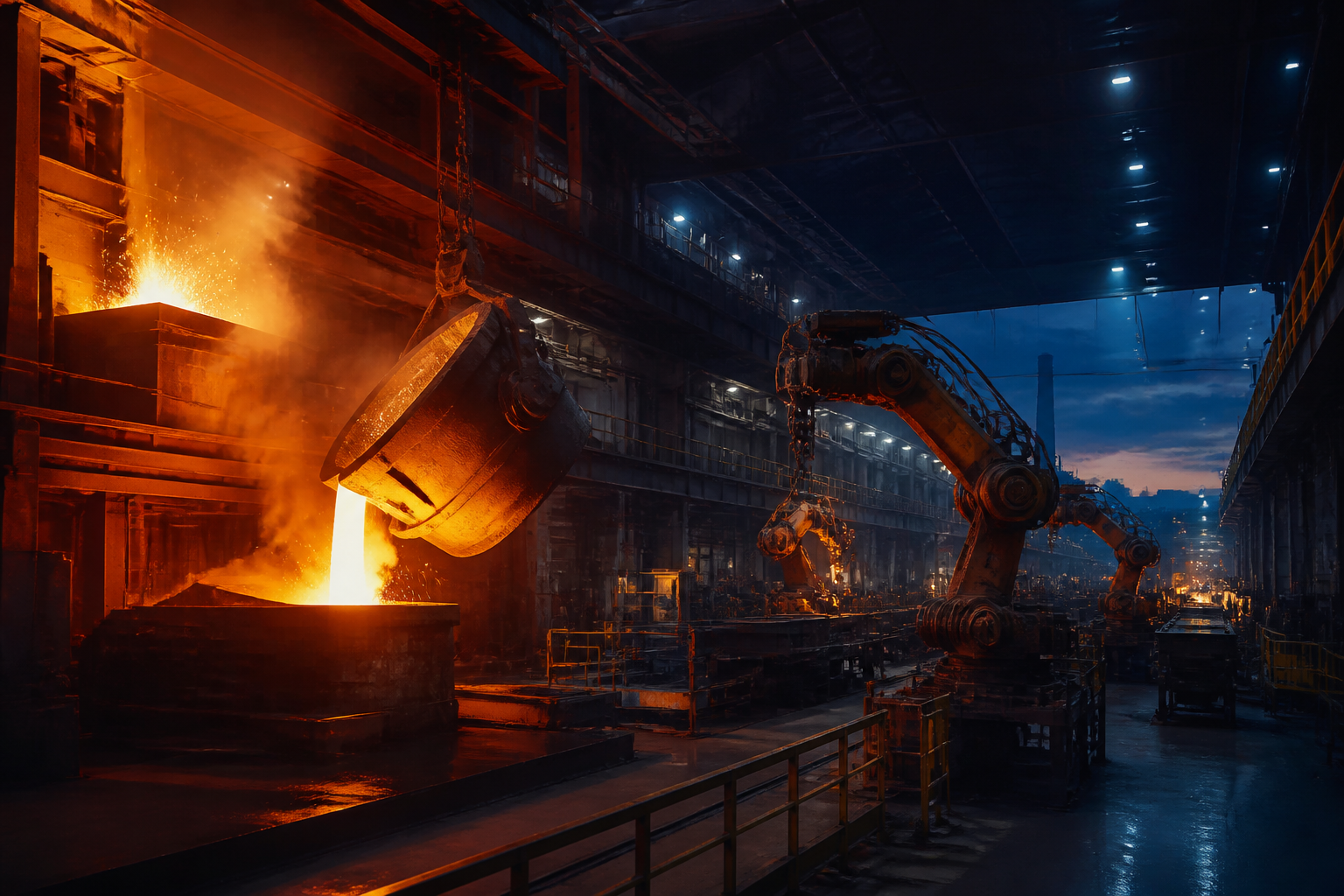
The Industrial Crossroad: Manufacturing Fragility and the Geopolitics of Resilience
An analytical deep dive into the shifting currents of global industry, examining the implications of recent ISM manufacturing data, South American structural risks, and the cooling of the Western labour market.
The global industrial complex is currently navigating a period of profound uncertainty, characterised by a divergence between resilient labour markets and stuttering manufacturing output. As the dust settles on recent quarterly reports, the prevailing sentiment within the boardrooms of the FTSE 100 and the S&P 500 is one of cautious retrenchment rather than exuberant expansion. The latest data points from the Institute for Supply Management suggest that while the services sector continues to underpin broad economic stability, the industrial heartlands are feeling the weight of sustained high interest rates and a fragmented international trade environment. The 'nut graf' of our current predicament lies in this: we are witnessing the end of the post-pandemic recovery phase and the commencement of a far more gruelling cycle defined by supply-side constraints and the geopolitical weaponisation of industrial capacity.
The Stuttering Engine of North American Industry
Recent data released by the Institute for Supply Management (ISM) reveals a manufacturing sector in the United States that is struggling to find its footing. With New Orders hovering at 56.0 and overall manufacturing output figures settling around the 70.9% mark, the optimism that characterised the start of the fiscal year is beginning to dissipate. This softening is not merely a statistical anomaly but a reflection of a broader cooling in capital expenditure. Major industrial conglomerates, from Caterpillar to John Deere, are confronting a landscape where the cost of borrowing has significantly dampened the appetite for large-scale equipment upgrades. Furthermore, the Federal Reserve’s hawkish stance on inflation, though arguably necessary, has created a paradox where the very measures intended to stabilise the economy are constricting the arteries of industrial production.
The jobs market, long the primary bulwark against a recessionary slide, is also showing signs of moderation. The most recent nonfarm payrolls report, indicating the creation of approximately 172,000 new positions, suggests a market that is returning to a sustainable, albeit slower, rhythm. For industrial leaders, this represents a double-edged sword. On one hand, the easing of wage pressure provides some relief to margins that have been squeezed by soaring energy costs and logistical bottlenecks. On the other, it signals a potential softening in consumer demand, which will inevitably filter through to the order books of durable goods manufacturers in the coming quarters.
Vulnerabilities in the Andean Corridor
While the developed economies grapple with interest rate sensitivities, the industrial outlook in South America remains tethered to institutional stability and the vagaries of natural disasters. The recent seismic events in Venezuela have exposed the profound fragility of the region’s infrastructure and the inadequacy of the state’s response mechanisms. For multinational firms with interests in the Andean region, this serves as a stark reminder of the 'tail risks' that accompany investment in emerging markets. The inability of the Venezuelan administration to mobilise an effective recovery effort underlines a broader trend of industrial atrophy, where a lack of maintenance and capital investment has left critical sectors, most notably oil and gas, highly susceptible to disruption.
However, this instability is not confined to Venezuela. Across the continent, from the copper mines of Chile to the agricultural hubs of Brazil, there is an increasing recognition that industrial resilience must be built on the foundation of robust governance. The 'Fault Lines' reported by The Economist are not merely geological but systemic. Investors are increasingly demanding premiums that reflect the risk of state failure or environmental catastrophe. In this context, the role of international development banks and private equity firms is shifting from mere capital provision to the active management of sovereign and environmental risk, a transformation that will redefine industrial partnerships in the Global South for the remainder of the decade.
The Resynchronisation of Global Supply Chains
For decades, the gospel of industrial management was efficiency above all else. The lean, just-in-time models pioneered by Toyota and perfected by Apple became the global standard. Yet, the disruptions of the past three years have forced a total re-evaluation of this philosophy. We are now entering the era of 'just-in-case' inventory management, where resilience is valued as highly as cost-efficiency. This shift is manifesting in a massive wave of near-shoring and friend-shoring, as Western firms look to decouple their supply chains from perceived geopolitical rivals. The beneficiary of this trend is not a single nation but a corridor of states, including Mexico, Vietnam, and Poland, that offer a blend of geographical proximity and political alignment.
Yet, this resynchronisation is not without its costs. The inflationary pressures generated by moving production from low-cost centres to higher-cost, more stable jurisdictions are permanent rather than transitory. The European Central Bank and the Bank of England are both keenly aware that the structural reordering of global industry will keep costs elevated for the foreseeable future. For the industrial sector, this necessitates a renewed focus on automation and artificial intelligence. If the cost of human labour and logistics is to remain high, the only path to margin preservation lies in the radical digitisation of the factory floor. The Fourth Industrial Revolution is no longer a futuristic concept; it is an immediate financial necessity for survival.
Central Banking and the Industrial Credit Cycle
The industrial sector is, by its very nature, capital-intensive, making it uniquely sensitive to the machinations of central bankers. The current trajectory of the Federal Reserve and its European counterparts suggests that the era of 'easy money' is firmly in the rearview mirror. As Yahoo Finance and Trading Economics calendars indicate, every upcoming inflation reading and interest rate decision is being scrutinised for clues as to when the pivot might occur. However, industrial leaders would be wise to prepare for a 'higher for longer' environment. The transition to a green economy and the massive infrastructure projects currently underway in the US and the UK require trillions in investment, which must now be financed at much higher yields than before.
This tightening of the credit cycle is triggering a consolidation within the industry. Smaller firms, unable to service the debts accrued during years of expansion, are being absorbed by larger, more liquid competitors. We are likely to see a flurry of M&A activity across the aerospace, automotive, and chemical sectors as firms seek to achieve the scale necessary to survive in a low-growth, high-cost environment. The role of the Chief Financial Officer has evolved from a back-office administrative function to a strategic pillar, as the management of the balance sheet becomes just as important as the management of the production line.
The Geopolitics of Energy and Industrial Sovereignty
No discussion of the industrial landscape is complete without addressing the fundamental input: energy. The geopolitical tensions in the Middle East and the ongoing conflict in Ukraine have shattered the illusion of energy security. For industrial powerhouses like Germany, the loss of cheap Russian gas has necessitated a painful and expensive restructuring of their entire manufacturing base. This shift towards industrial sovereignty, where states seek to secure their own energy and raw material supplies, is driving a new form of industrial policy. Governments are now providing unprecedented levels of subsidies for domestic semiconductor production and green energy technologies, as seen in the American Inflation Reduction Act and the European Green Deal.
This interventionist approach marks a significant departure from the neoliberal consensus of the late 20th century. While these subsidies have provided a temporary boost to industrial construction indices, they also risk sparking trade wars and distorting global markets. The challenge for the coming years will be to balance the need for national security with the benefits of global trade. The industrial sector finds itself at the heart of this tension, as companies must navigate a landscape of increasingly complex regulations and local content requirements. The ability to manage these geopolitical risks will be a key differentiator between the winners and losers of the next decade.
Towards a New Industrial Equilibrium
Looking ahead to the final quarter of the year and into the next, the path for global industry is paved with both peril and opportunity. We expect to see a stabilization of manufacturing indices as firms complete their inventory adjustments and the effect of government stimulus begins to take hold in the green energy and infrastructure sectors. However, the period of rapid, globalised growth is over, replaced by a more fragmented and volatile environment. The industrial firms that thrive will be those that embrace technical innovation, demonstrate agility in their supply chains, and maintain the financial discipline to weather the inevitable shocks of a changing geopolitical order.
The forward-looking outlook suggests that while the 'paltry' responses to crises in regions like Venezuela highlight the risks of neglect, the proactive restructuring in the West signals a new chapter of industrial resilience. The focus for the next eighteen months will be on the 'Three Ds': Digitisation, Decarbonisation, and De-risking. Progress in these areas will determine whether the current manufacturing slowdown is a temporary hurdle or the beginning of a prolonged structural decline. For the astute investor and the strategic leader, the current volatility is not a signal to retreat, but a prompt to recalibrate for a more complex, yet ultimately more robust, industrial future.