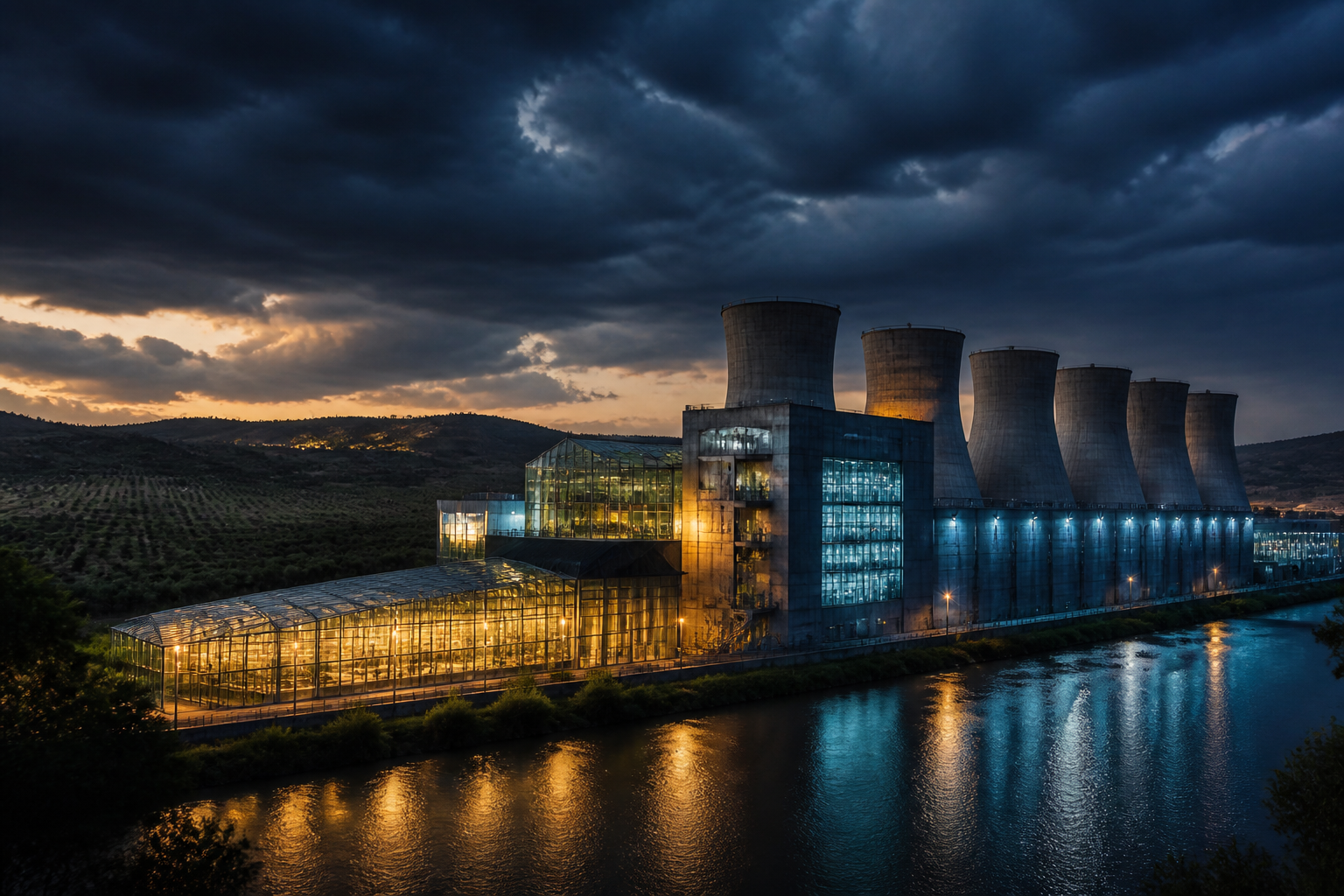
The Ghost in the Ledger: Dissecting the Industrial Cost of the Artificial Intelligence Hegemony
Economic & Actu examines the deepening rift between speculative valuation and industrial reality. From the hidden costs of Big Tech to a resurgence in regional agricultural manufacturing, we map the new economic landscape.
The global industrial complex currently finds itself at a precipice where the intoxicating allure of artificial intelligence meets the cold, uncompromising reality of the balance sheet. For several quarters, the narrative of modern capitalism has been dominated by a singular focus on the transformative potential of deep learning and generative models. However, beneath the buoyant indices and the frequent market rebounds documented by institutions such as Investors Business Daily, a more troubling trend is emerging. The true cost of this digital revolution remains obscured by a layer of accounting opacity that masks the extraordinary capital expenditure required to sustain the current momentum. As the market closes out periods of volatility, with companies such as Vertiv and MaxLinear serving as bellwethers for infrastructure demand, the disconnect between recorded profits and long-term capital depreciation suggests that the industry is entering a phase of profound financial re-evaluation. The epoch of cheap, scalable software is giving way to an era of expensive, energy-intensive hardware, necessitating a fundamental shift in how analysts and editors alike perceive industrial health.
The Accounting Mirage and Capital Intensivity
Recent investigations into the financial disclosures of the world’s largest technology firms reveal a systemic reluctance to provide a granular accounting of artificial intelligence expenditures. The current reporting standards, as observed by analysts such as Kevin Koharki and the editorial board at the Wall Street Journal, allow for a convenient blurring of lines between traditional cloud infrastructure and the specialised, high-cost clusters required for large-scale model training. This obfuscation is not merely a matter of bureaucratic preference; it is a strategic necessity to maintain investor confidence in margins that may be thinner than they appear. When the depreciation of specialised chips and the skyrocketing costs of data centre cooling are factored into the equation, the return on investment for AI looks increasingly speculative rather than immediate. This phenomenon creates a 'ghost in the ledger,' where the liabilities associated with rapid technological obsolescence are deferred, creating a potential fiscal cliff for the next decade of industrial planning.
Regional Resurgence and the Mid-Market Pivot
While the headlines are dominated by the silicon valleys of the world, a quieter but equally significant industrial shift is occurring within the terrestrial heartlands of the United States and the United Kingdom. CNBC’s longitudinal study into America's Top States for Business, now entering its twentieth year, highlights a critical migration of capital toward regions that offer structural stability rather than merely tax incentives. This is exemplified by the recent developments in Madison County, where a multi-million dollar agricultural project is set to revitalise the local economy. This facility represents a broader trend of integrating high-tech processing with traditional primary industries, creating a hybrid industrial model that is more resilient to the fluctuations of the global software market. By anchoring technological advancement in the tangible outputs of the agricultural sector, these regions are demonstrating that industrial growth in 2026 is as much about the efficiency of the supply chain as it is about the sophistication of the algorithm.
Geopolitical Frictions and the Diplomacy of Industry
Industrial policy can no longer be decoupled from the shifting sands of international diplomacy. The recent delays in high-stakes negotiations involving figures such as JD Vance regarding Iranian relations, alongside the domestic electoral victories of regional leaders like Andy Burnham in the United Kingdom, underscore a fragmented geopolitical environment. For the industrialist, this means that the globalised supply chain is being replaced by a more cautious, localised strategy often termed 'friend-shoring.' The ability of a nation to secure its energy and food supplies, as seen in the Madison County agricultural expansion, has become a primary metric of investment attractiveness. We are witnessing the end of the seamless global trade era, replaced by a world where industrial success depends heavily on a company's ability to navigate a thicket of regional regulations and geopolitical alliances. The stability of the British North, under bolstered local leadership, offers a counterpoint to the centralisation of power in London, suggesting that the future of industrial policy lies in empowered regional hubs that can act independently of central government indecision.
The Infrastructure Bottleneck and the Vertiv Effect
If the software layer of the current industrial revolution is clouded by accounting ambiguity, the hardware layer is defined by an uncompromising physical bottleneck. The performance of stocks like Vertiv, which specialises in data centre cooling and power management, serves as a grounded reality check for the broader market. The demand for industrial-grade cooling and power transmission infrastructure is currently outstripping supply, creating a ceiling for how fast the artificial intelligence sector can actually expand. This infrastructure crunch is not limited to the digital realm; it extends to the very power grids and logistics networks that support modern manufacturing. As the week's market action settles, it is clear that the 'picks and shovels' of this era are not just chips, but the massive, energy-hungry cooling systems and electrical transformers that allow those chips to function. For the discerning investor and the industrial strategist, the focus must shift from the output of the model to the sustainability of the shed.
Reframing the Corporate Narrative for 2027
As we look toward the latter half of the decade, the criteria for industrial leadership are being rewritten. Total shareholder return is no longer the sole metric of viability; instead, resource efficiency and capital transparency are coming to the fore. The aforementioned agricultural boost in Florida’s Madison County illustrates a vital point: the most successful industrial entities will be those that can demonstrate a direct, positive impact on local employment and resource management. Similarly, the pressure on Big Tech to clarify its R&D spending will only intensify as the 'AI premium' begins to erode from stock prices. Companies will be forced to move beyond the experimental phase of generative technology and prove that these tools can generate cold, hard cash flows that exceed the staggering cost of their development and maintenance. The industrial sector is, in many ways, returning to its roots, valuing the production of tangible goods and the maintenance of essential infrastructure over the ephemeral promises of the digital frontier.
The Horizon of Strategic Realism
In conclusion, the outlook for global industry is one of cautious, strategic realism. The initial euphoria surrounding the rapid adoption of new technologies is being tempered by the logistical and financial realities of their implementation. In the coming years, we expect to see a significant correction in how technology-led industrial growth is reported and valued. This will likely lead to a divergence between companies that have built sustainable, integrated supply chains and those that have relied on the opacity of their financial statements to sustain growth. Regionalism will continue to flourish, as states and counties that invest in physical infrastructure and local talent, rather than mere digital services, emerge as the new victors in the global competition for capital. The industrial map of 2030 will not be defined by the reach of a company’s software, but by the resilience of its physical footprint and the clarity of its economic contribution. The 'ghost in the ledger' will eventually be exorcised, and in its place, a more honest, more robust industrial era will begin.