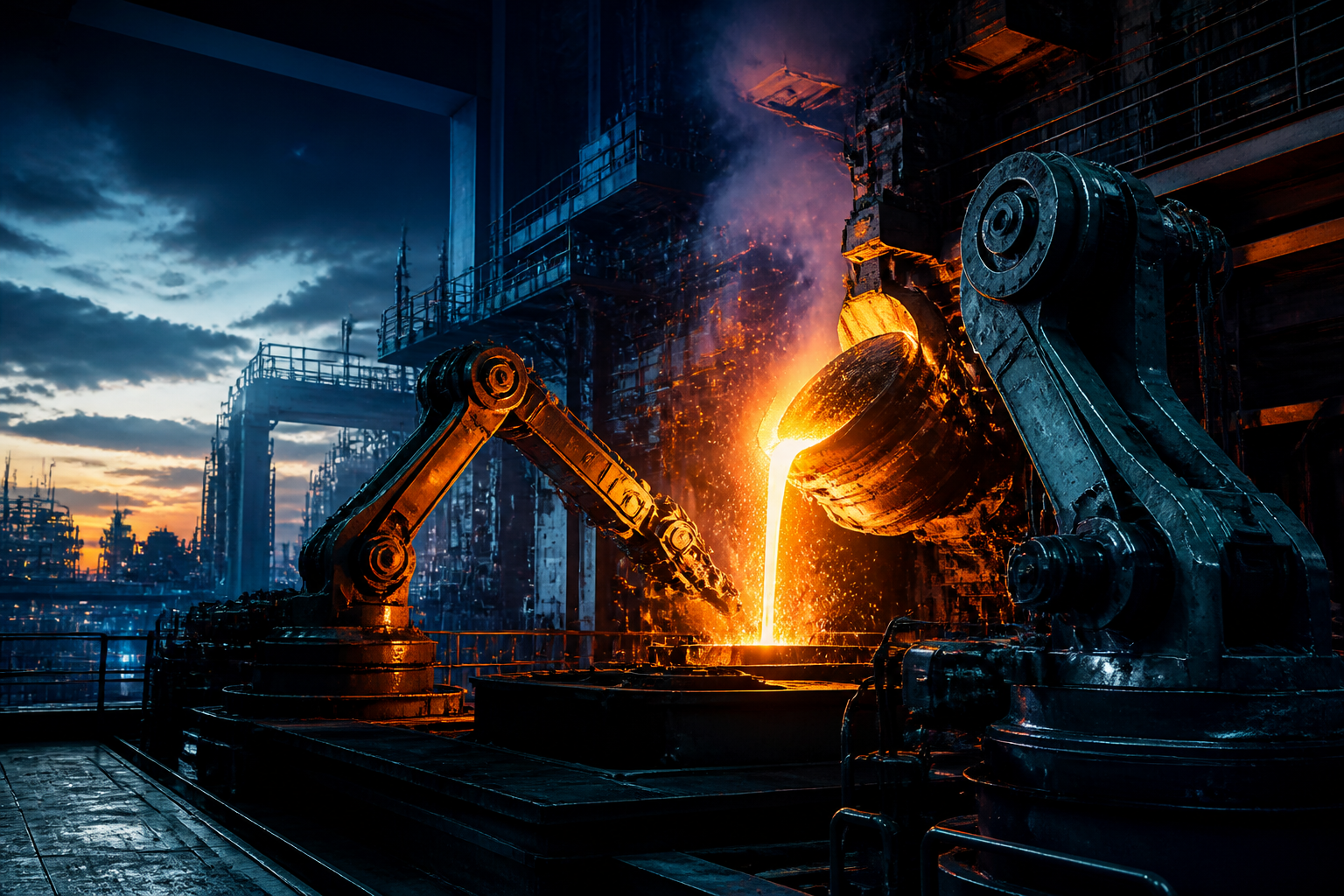
The Decalibration Of Global Industry: Navigating The New Mercantilist Frontier
A deep dive into the systemic shifts within the global industrial complex, examining how the resurgence of protectionism, high-interest rates, and the green transition are reshaping the future of fabrication.
The global industrial complex is currently undergoing its most profound structural realignment since the fall of the Berlin Wall, moving from a paradigm of cost-optimised efficiency to one of resilient sovereignty. The halcyon days of the 'just-in-time' delivery model, which defined the 1990s and 2000s, have been unceremoniously dismantled by a trifecta of geopolitical volatility, chronic supply chain fragility, and a resurgence of dirigiste economic policy. Today, the boardrooms of the Ruhr Valley, the Pearl River Delta, and the American Midwest are no longer solely occupied with marginal cost savings; instead, they are consumed by the exigencies of securing raw material pipelines and navigating an increasingly fragmented institutional landscape. This shift represents more than a temporary disruption; it is a fundamental decalibration of how value is created and distributed across the globe, as the invisible hand of the market finds itself increasingly guided by the visible fist of the state.
The Return of the Developmental State
For decades, the prevailing economic orthodoxy dictated that governments should remain at the periphery of industrial development, acting merely as referees in a global game of comparative advantage. However, the introduction of the Inflation Reduction Act (IRA) in the United States and the European Union’s subsequent Green Deal Industrial Plan have signalled the end of this non-interventionist consensus. Washington’s commitment of nearly four hundred billion dollars in subsidies and tax credits has forced a competitive reaction from Brussels and Tokyo, creating a subsidy race that threatens to sideline developing economies. This return to the developmental state suggests that the competitive edge in high-tech manufacturing is no longer determined by labour costs or infrastructure alone, but by the depth of a nation’s fiscal pockets and its willingness to engage in protectionist posturing. The shift toward such an 'industrial policy arms race' is redefining the relationship between capital and the consulate, making geopolitical alignment a primary factor in corporate strategy.
The German Impasse and the European Core
Nowhere is this decalibration more visible than in the Federal Republic of Germany, the historical engine of European industry. The German model, predicated on cheap Russian energy, an insatiable Chinese demand for precision machinery, and a security umbrella provided by the United States, has faced a systemic collapse of its foundational pillars. With energy costs in the Eurozone remaining stubbornly decoupled from their pre-pandemic baselines, heavyweights such as BASF and ThyssenKrupp have been forced to reconsider their domestic footprints, often pivoting towards the United States or China to maintain viability. The dilemma facing the European Commission is whether to fully embrace a more protectionist stance to shield its automotive and chemical sectors from state-subsidised Chinese competition, or to maintain its commitment to open markets at the risk of further deindustrialisation. The tension between the need for cheap Chinese photovoltaic technology and the desire to build a sovereign European battery supply chain encapsulates the broader struggle of a continent attempting to find its place in a bipolar world.
China’s Pivot to the New Trio
As Western economies grapple with inflation and re-shoring, Beijing has embarked on an ambitious pivot to what it calls the 'new three' drivers of growth: electric vehicles, lithium-ion batteries, and renewable energy products. This strategic redirection is a response to the cooling of the over-leveraged domestic property market and a recognition that the era of low-end manufacturing dominance has passed. By directing state-backed credit into these high-growth sectors, China has achieved a level of vertical integration that is the envy of its competitors. Entities such as BYD and CATL now command significant portions of the global value chain, exerting a gravitational pull that makes decoupling an increasingly Herculean task for Western policymakers. However, this surge in industrial capacity has led to accusations of endemic overcapacity, as Chinese factories produce more than the global market can absorb without significantly depressing prices, further straining trade relations with the G7 nations.
The American Resurgence and the Cost of Capital
Across the Atlantic, the United States is attempting an industrial renaissance that would have seemed improbable a decade ago. The CHIPS and Science Act has catalysed a surge in domestic semiconductor fabrication, with Intel and TSMC breaking ground on gargantuan facilities in Arizona and Ohio. Yet, this manufacturing boom is occurring within a high-interest-rate environment that has fundamentally altered the calculus of capital-intensive projects. The era of 'free money' that fuelled the tech booms of the 2010s is over, and industrial firms must now demonstrate rigorous fiscal discipline while simultaneously investing in the expensive automation technologies required to offset high domestic labour costs. The persistence of the Federal Reserve’s restrictive stance has created a bifurcation in the market: large-cap firms with robust balance sheets are successfully navigating the transition, while smaller-tier suppliers are struggling under the weight of debt service and the rising costs of raw materials.
The Fragility of Critical Mineral Corridors
The industrial sector’s transition to a low-carbon future is entirely dependent on a new geography of extraction. The shift from hydrocarbons to electrons has replaced the reliance on the Strait of Hormuz with a reliance on the lithium brines of the Atacama Desert and the cobalt mines of the Democratic Republic of the Congo. This new 'mineral mercantilism' has triggered a scramble for resources that mirrors the Great Game of the nineteenth century. Australia and Canada have emerged as critical partners for the West, as they seek to build 'friend-shoring' networks that bypass Chinese processing dominance. However, the technical difficulty and environmental impact of developing these new mineral corridors mean that supply often lags behind the ambitious timelines set by Western governments for the electrification of transport. Industry leaders must now act as amateur geologists and diplomats, securing long-term offtake agreements with junior miners to ensure their production lines do not come to a grinding halt for lack of rare earth elements.
Automation as a Demographic Necessity
While trade barriers and energy costs dominate the headlines, a more silent revolution is taking place on the factory floor: the rapid acceleration of industrial automation and generative artificial intelligence. For the first time, this technological push is being driven not only by a desire for increased productivity but by an encroaching demographic winter. In markets ranging from Japan and South Korea to Italy and Germany, the shrinking of the working-age population is no longer a distant projection but a present reality. The adoption of 'cobots', collaborative robots that work alongside humans, and AI-driven predictive maintenance is becoming essential to maintaining current output levels. This shift is recalibrating the labour market, creating a premium for high-skilled systems engineers while hollowing out traditional manual roles. The challenge for the coming decade will be ensuring that the gains from this increased productivity are widely distributed, avoiding a scenario where industrial hubs become automated islands of wealth surrounded by economic stagnation.
A Forecast of Competitive Resilience
Looking ahead, the global industrial landscape will likely be defined by a movement toward 'modular globalisation.' Rather than pursuing a single, unified global market, industrial giants will increasingly operate within distinct regional blocs, each with its own regulatory standards, energy sources, and subsidy regimes. This more fragmented world will be inherently more expensive, as the efficiencies of a global division of labour are sacrificed for the security of local supply. We expect to see a significant increase in joint ventures between public and private sectors, as the risks of large-scale industrial projects become too great for private capital to bear alone. Success in this new era will require a radical degree of agility; the winners will be those firms that can navigate the thicket of new trade regulations while maintaining the pace of technological innovation. The decalibration of industry is near its completion, and the next phase will be the construction of a sturdier, though undeniably more complex, global apparatus.