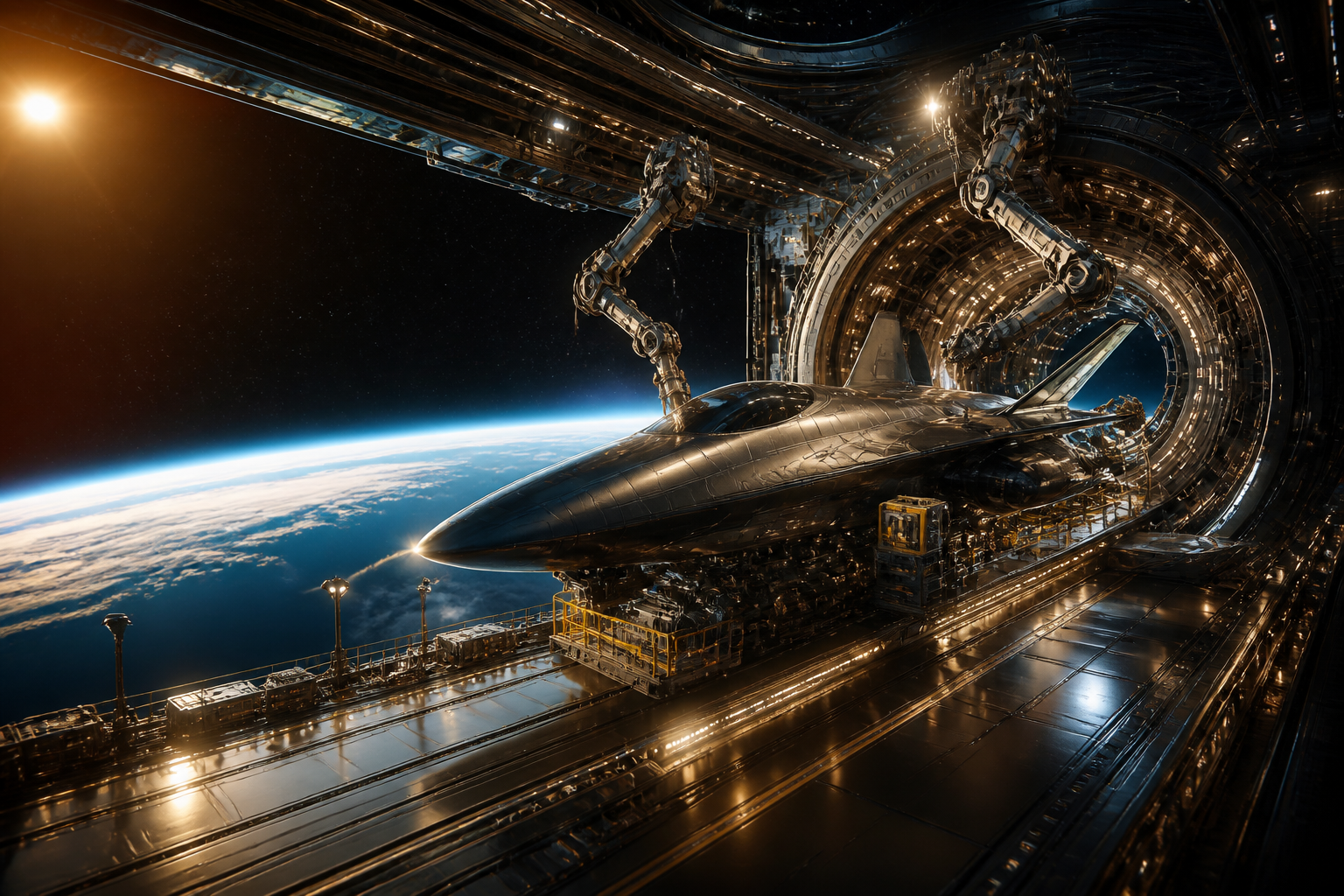
Astral Arbitrage: The Final Frontier Of The Industrial Complex
As commercial space exploration ventures such as SPCX transition from speculative assets to industrial pillars, the convergence of orbital dominance and artificial intelligence is redefining global equity markets.
The global financial apparatus is currently witnessing a profound architectural shift, as the historical boundaries between telecommunications, defence, and transportation dissolve into a singular, extraterrestrial industrial complex. While equity markets have recently exhibited a cautious temperament, reflected in the marginal dip of global shares following the suspension of diplomatic overtures between Washington and Tehran, the underlying momentum of the 'space economy' remains remarkably insulated from terrestrial geopolitical volatility. The resurgence of interest in Space Exploration Technologies Corp (SPCX) and its peers signifies more than a mere speculative bubble; it represents the institutionalisation of the cosmos as a viable theatre for commercial expansion. As oil prices retreat and traditional energy dependencies face structural scrutiny, the investment community is pivoting toward orbital assets as the new frontier of long-term value preservation. This editorial explores the nexus of high-altitude logistics, semiconductor advancement, and the escalating race for celestial hegemony.
The Institutionalisation Of Orbital Capital
For decades, the vacuum of space was the exclusive province of state actors, funded by sovereign treasuries and motivated by Cold War posturing. However, the contemporary landscape is defined by a radical democratisation of launch capabilities, led by private entities that have successfully commoditised low-earth orbit (LEO). Institutional investors, once wary of the capital-intensive nature and prolonged gestation periods of orbital ventures, are now re-evaluating their portfolios. The performance of SPCX and related indices suggests that the market is beginning to price in the recurring revenue models of satellite constellations rather than the binary outcomes of individual rocket launches. This shift reflects a maturing sector where reliability and frequency have superseded the novelty of flight, allowing for the creation of sophisticated financial instruments tied to orbital throughput and data latency. The influx of institutional capital is not merely funding hardware; it is underwriting the infrastructure of a new global connectivity layer that operates beyond the jurisdiction of traditional terrestrial borders.
Synergies Of Silicon And Steel
Central to the current resurgence in technology equities is the symbiotic relationship between artificial intelligence and the burgeoning space sector. As noted in recent market updates, software conglomerates are poised to reap significant dividends from the deployment of AI at the 'edge', in this instance, within the satellite clusters themselves. The sheer volume of data generated by modern Earth observation and signals intelligence requires on-orbit processing to bypass the constraints of downlink bandwidth. Consequently, the semiconductor industry is pivoting to produce radiation-hardened AI chips capable of enduring the rigours of space while executing complex cryptographic and analytical tasks. This convergence is creating a feedback loop: more efficient AI allows for more autonomous and resilient satellite networks, which in turn provide the real-time global data necessary to train the next generation of predictive algorithms. For companies at the intersection of these fields, the value proposition lies in their ability to provide integrated solutions that bridge the gap between terrestrial data centres and orbital observation platforms.
Geopolitics And The Frigid Peace
The collapse of peace talks between U.S. and Iranian negotiators has served as a poignant reminder that while technology evolves, the fundamental frictions of the Westphalian system remain. Global markets reacted with a characteristic flight to safety, yet the volatility was tempered by an unexpected resilience in U.S. stock indices. This divergence suggests that the market now differentiates between localised regional instability and the broader trajectory of the technological-industrial base. The strategic importance of space has never been more acute; orbital superiority is now the prerequisite for terrestrial influence. Consequently, we are seeing the emergence of a dual-track economy: one that remains tethered to the traditional cycles of the energy market and regional conflicts, and another that is increasingly decoupled from these constraints, driven by the race for lunar base capabilities and the control of strategic orbital slots. The militarisation of space, though often discussed in hushed tones in boardrooms, is providing a silent but substantial floor for the valuations of aerospace and defence contractors who are pivoting their core competencies toward the stars.
Inflationary Pressures And The Search For Alpha
As Wall Street awaits critical inflation updates, the broader economic narrative remains one of cautious recalibration. The Federal Reserve's ongoing battle with price stability has forced a reconsideration of growth-at-any-cost models. In this environment, investors are particularly sensitive to the economic calendar, seeking signals that the tightening cycle may finally be reaching its zenith. The recent decline in oil prices has provided a much-needed reprieve for global manufacturing hubs, yet it has also signalled a potential cooling of industrial demand. Within this macroeconomic crucible, the space and AI sectors offer a unique proposition: they are inherently disinflationary. By optimising global logistics, improving agricultural yields through precision satellite monitoring, and automating complex industrial processes, these technologies exert a downward pressure on costs. Therefore, the capital flowing into the space sector should not be viewed as inflationary excess, but rather as a strategic investment in the very tools required to manage the scarcity of the late-twenty-first century.
The Regulatory Vacuum And Sovereign Risks
Despite the rapid pace of technological deployment, the legal and regulatory frameworks governing the extraterrestrial commons remain antiquated. The 1967 Outer Space Treaty, while a foundational document of international law, did not envision a world where private corporations possessed more launch capacity than sovereign states. This regulatory ambiguity presents both a risk and an opportunity for the global corporate elite. On one hand, the lack of clear property rights regarding lunar resources or orbital debris mitigation creates a 'tragedy of the commons' scenario that could jeopardise the long-term viability of the sector. On the other hand, the first-mover advantage for companies that can establish de facto norms is immense. We are likely to see the emergence of 'flag of convenience' jurisdictions for space ventures, similar to the maritime industry, where nations with favourable regulatory and tax regimes compete to host the world’s leading satellite and launch providers. For the discerning investor, navigating this patchwork of global regulations will be as critical as assessing hardware specifications.
A Vision Of Orbital Manufacturing
Looking further ahead, the long-term potential of the space economy lies not just in what we can send up, but in what we can produce there. Microgravity environments offer unique conditions for the synthesis of pharmaceuticals, the growth of high-purity protein crystals, and the manufacturing of advanced materials that are physically impossible to create within Earth’s gravity well. Several biotech and materials science firms have already begun pilot programmes to leverage the International Space Station and private orbital labs for R&D. While large-scale orbital manufacturing remains a decade or more away, the foundational infrastructure is being laid today. The transition from space-as-a-service (SaaS) to space-as-a-factory (SaaF) will mark the next great leap in industrial evolution. This is where the true 'alpha' resides for the institutional holder: in the transition from a logistics-based economy to a production-based economy founded on the unique physics of the orbital plane.
The Forward-Looking Outlook
The trajectory of the global economy is increasingly being plotted on a celestial map. In the coming quarter, we expect to see a consolidation of the space sector as mature players like SPCX acquire smaller, niche technology firms to bolster their end-to-end capabilities. The market will likely remain sensitive to U.S. inflation data and Federal Reserve rhetoric, but the structural shift toward an integrated AI-Space industrial complex appears irreversible. Investors should prepare for a period of heightened 'orbital diplomacy,' where corporate interests and national security objectives become indistinguishably entwined. While terrestrial geopolitical tensions, such as those in the Persian Gulf, will continue to provoke short-term market fluctuations, the long-term thesis remains grounded in the expansion of the human economic sphere beyond the atmosphere. The most successful enterprises of the 2030s will be those that have successfully navigated the transition from being masters of the Earth to being the architects of the new solar economy. The final frontier is no longer a vacuum; it is a burgeoning marketplace.